It is interesting to see how AMC shifted from a station that played classic movies, to a producer of first-rate entertainment fare. AMC shows have garnered critical and popular acclaim. They have also stirred a lot of thinking because they contain meta-narratives: surrounding one very flawed hero/anti-hero. Breaking Bad is perhaps the most widely known; its fans watched with rapt attention as the mild mannered dying chemistry teacher who had a lot of hard luck turned into a hardened criminal mastermind. At last, in the final operatic episode, he could finally admit to his wife, "I did this for me." Then, he perishes among the gleaming equipment of the most spectacular meth lab the world has ever seen.
Likewise, Mad Men, with its dashing, semi-tragic anti-hero Don Draper and his artificial reality, causes us to ask similar questions of meaning and purpose. Who are we supposed to root for, here? Is there redemption for Don Draper, even as there wasn't for Walter White? We have been given a glimpse that perhaps there might be, but there are 7 episodes left until we find out.
The newest of the crop is Hell on Wheels, a highly fictionalized account of life in the old West, and the race to build the first trans-continental railroad. The show is not for the faint of heart --there are far too many cringe-inducing scenes. The series centers on the troubled anti-hero Cullen Bohannon, a former Confederate soldier whose wife and son were butchered by a group of Union soldiers. Bohannon's initial mission was to hunt each of these men down, and carry out vigilante justice. In the meanwhile, he executes an innocent man in his hunt for the last perpetrator. His fate becomes entwined with that of the Union Pacific railroad, and he becomes the de facto leader of the workforce. Along the way, we discover that, despite his rough exterior, he is an educated gentleman who had married into an aristocratic family. I write this as I have just begun to watch Season 3, so all of what I say ought to be taken with that in mind.
Bohannon is on a spiritual quest. Everything he loves seems to get destroyed, and death follows in his wake, claiming innocent victims. Thus far, Bohannon has turned to the church three times, seeking redemption. The first time, the frontier preacher who has gone insane tells him that there is a choice between love and hate. The preacher counsels, "Choose hate," whereupon Bohannon murders the innocent soldier he thought was responsible for murdering his family. All the while, the man protests that he can prove his innocence by the discharge paper he held in his hand.
The second time, Bohannon again approaches the church. The female evangelist who has taken her late father's place tells him she doesn't think that redemption is available for everyone.
The third time, Bohannon is in New York, after the great Sioux massacre that nearly brought the end of the Union Pacific project. He is there to convince the board to appoint him as chief engineer. While there, he visits the church where he and his wife were married, repenting for what he has done. The pastor approaches him. Bohannon asks him if he remembers him. He doesn't, and keeps referring to himself in the plural. He tells Bohannon he is allowed to stay, but he must leave his guns at the door.
Now, two crazy preachers and one evangelist who doesn't seem to grasp the gospel may simply be a screed against organized religion, and this would not surprise. But, there may be more at work. Time will tell. The big question of the show seems to be "Will Bohannon find redemption, and, if so, from where?" If the series ultimately ends like most, it will be that he has found peace of mind in some bucolic setting with a pretty wife. I hope it doesn't. Redemption and peace of mind are not the same thing. Equally, I hope it doesn't end with him face up at the bottom of a gorge somewhere, lost in existential despair like a Clint Eastwood movie.
The larger question is why these series, which are essentially morality plays, capture the imagination of a secular populace. My inkling is that it is because there is no secular populace, at least not, if we mean a populace unconcerned with some sort of transcendent realities like justice, hope, love, and redemption. It's dangerous to comment on either a book or a series before its ending, but this appears to be the case being made by James K. A. Smith in his little book How Not to Be Secular. Smith is trying to appropriate the thoughts of the rather inaccessible philosopher Charles Taylor, and bring him to a broader audience. The opening contention of the book is that what separates our age from earlier ones is that people have found ways of constructing meaning and purpose without reference to God, and that the church has been slow to figure this out, and thus seeks to answer the questions nobody is asking today. I think he's on to something --the question is how this ought to change our approach.
I think the morality plays give us an inkling. Why are they powerful? First of all, they are stories. They ask big questions, but not in the setting of the lecture hall. They involve the emotions even as they engage the mind. Second, they are very well-done. As banal as much of pop culture is, the well-made movie or series appears to be the only thing in which the audience still appreciates something well-crafted. Now, I don't think the church ought to substitute drama for proclamation --we never seem to do that very well, and, when we do it, the message is so overt that it converts precisely zero people. The lesson is more subtle.
These series, like Scripture, confront the viewer with an unblinking lens into human corruption. Nobody is entirely pure. Everyone is corrupt and does something reprehensible. There is senseless death. Reality is bleak. Yet, there is beauty. Mad Men is a lot of very attractive people set in a suave and sophisticated 60's Manhattan, darkened as it is by the crime epidemic. It is desperation fashionably done. Hell on Wheels is set in the glories of the unspoiled American West (it is actually filmed in Alberta). Against the beauty of what God created (Hell on Wheels) and what man created (Mad Men), is the moral ugliness of human nature, and the big question: how can one who knows who he is what he has done find ultimate peace? Both Don Draper and Cullen Bohannon look to the bottom of a bottle, and it is failing them.
The church has the advantage of story. God gives us his truth largely in the midst of story --stories filled with anti-heroes and moral ugliness wherein even those who wear the white hats have very fatal flaws. This is the story of grace. If there is a quest for redemption that is shown in the entertainment media, then the church can answer that question. But, we have to find different ways than pat formulas and tracts and questions. Post-modernity is presenting us with opportunities, and we need to realize that modernity and its rationalistic basis were not naturally friendly to Christian belief. Post-modernity is more open to enchantment, and it is our task to enchant. We have the greatest "fable" (and the only true one) in the history of the world. It is to our shame if we can't tell the story in a way that taps into the human quest for wonder, for purpose, and for redemption.
I will be the first to say that I have not figured out how to do this yet. It is very hard for the leopard to change his spots. Yet, we cannot get to answers if we never ask the question.
Tuesday, November 25, 2014

Wednesday, September 24, 2014
"History," Henry Ford said, "is bunk!" or some thoughts, inspired by the Roosevelt's.
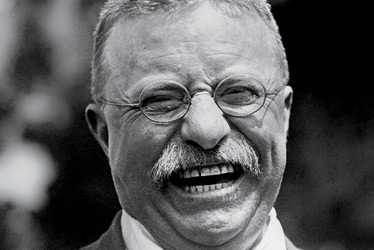
Note first: there are bad guys in history, people about whom the only redeeming thing that can be said is they did not murder their own mothers. We know who these are.
The record on most other people is decidedly mixed. The problem with the "hero-villain" approach to historiography (that's how we write history, please try to stay awake) is that when we find our heroes, we either minimize or downright deny their flaws. Jefferson was a great man, therefore we refuse to admit he wasn't a Christian, or had an affair with a slave. He simply couldn't have! It tarnishes his shiny badge.
What got me thinking about this is watching Ken Burns's series on the Roosevelt's. It is not the series itself, which I think is thus far very well done (I've only seen 6 hours of the 14). It is, rather the response to it by Amity Schlaes. Ms. Schlaes's argument, in brief, is that Ken Burns makes the Roosevelt's into heroes, when they ought to be regarded as villains. TR broke up the trusts which caused the railroads to crash (on Wall Street, not on the rails), and his old foe, white hat J. Pierpont Morgan, had to ride over the ridge to save the day! Big business good! Meddling federal government bad! But, Ms. Schlaes overlooks a very inconvenient fact in this narrative, which is that many of the trusts were built in complicity with the government. In other words, big business and big government were often in cahoots against the little guy. Burt Folsom does an excellent job of putting this on display in his book The Myth of the Robber Barons. The narrative isn't big business as the good guys, and an overweening federal government as the bad guys. Big business did some bad things, and so did the government. Both did good things, too.
I'm not sure Ms. Schlaes would feel the same about TR had she survived the Triangle Shirtwaist fire or had to eat some of that delectable Chicago slaughterhouse meat, or if she had, at the age of nine, to work 12 hour days in a factory and go home to a dumbbell tenement. I'm not arguing here for whether or not the federal government has a role in those sorts of things, that is an argument for another time. The point is, history is complicated and Ms. Schlaes tries to separate out heroes and villains. Don't. Let human beings be human beings be fully drawn with all their warts and their massive failings. Mighty triumphs are not minimized by human frailties.
We read the Bible looking for heroes and villains too. Children's Bibles make the patriarchs and David out to be heroes. Yay! Look at David, slaying those Ammonites. Look how trusting Abraham was, offering up Isaac on the altar, knowing God could raise the dead! Reading through Genesis and 1 & 2 Samuel will smash your rose colored glasses. All of God's people had serious, awful flaws. They did things that, were the average elder to do them today, would get him not only defrocked, but probably flogged. If he repented, we might grant him forgiveness. But we'd watch him, alright. There but for the grace of God we go.
Which brings us to grace, which is what it is all about. Part of looking for heroes and villains is convincing ourselves of our own righteousness. We find those with whom we can compare ourselves favorably, and think, "I thank thee that I am not as other men are....and especially not like that tax collector!" God has helped me be righteous --that's my "gospel" as I live it out, even if my words say otherwise. It is no gospel at all. The only gospel is "God have mercy on me, a sinner, because of what your son did on my behalf." Grace is realizing I am as messed up as anyone else is. Grace is a God who loves big time sinners like Jacob and Abraham and David. Decent people don't think they need grace. I am anything but decent, from the inside out.
So, Mr. Ford, history isn't quite bunk, but we can present it that way. Let's not.
Tuesday, February 11, 2014
An Appreciation for Donald Miller, and a Few Thoughts

First, an Appreciation and a gentle nudge (or, "Unless you're Anne Frank, the "details of your life are quite inconsequential, really.")
Yes, that is a quote from Dr. Evil. I must confess, unlike other members of the "Reformed, confessional, neo-Puritan, Old School, experiential tribe," I rather liked Miller's Blue Like Jazz. I found it honest yet orthodox, unlike others of that particular genre, which, if I would mention, might ring a Bell, and Rob my current blog of its focus.
My sole critique of Blue was that it revealed a self-obsession and a self-importance that I think was the farthest thing from the author's intent. The details of Anne Frank's daily life are riveting because she didn't know she was writing for an audience, oh, and she lived in hiding and was killed by the Nazi's. She wasn't deciding what was really the fair-trade organic coffee in the aisle of Whole Foods. But, he gave voice to the frustrations many (if not all) of us have with life in community.
So, when Donald Miller says that he finds Christian fellowship better in a group of self-selected friends than in the church, he's missing something. It's not all that different from the old sentiment "I love humanity, it's people I can't stand." He's missing the point that people are supposed to rub you the wrong way in the church, and you are supposed to love them anyways.
In that way, church relationships are far more sanctifying than friendships. After all, if a friend is difficult, we have ways of making him a "former friend." Not very godly, but it happens often. Even Christians cast off people they find taxing, even though it is an ungodly thing to do. But, in the church, we have no choice but to deal with people who don't like us very much, and to love them with the sort of love Christ has for us, as unlovable as we are.
Second, post-modernity is not as post-modern as you think (or what the not-as-young-as-he-once-was post-evangelical can learn from the old Neo-Orthodox guy).
Miller equates sermons with lectures, and thus with a modern, or Enlightenment view, of education primarily as the impartation of information. He says he has learned little from sermons because he cannot remember any of them in particular. News flash: I don't remember what I preached on two weeks ago either. That is not how sermons work, and it belies a modernist assumption about both learning and preaching. In the New Testament model, preaching is not primarily an information-dump on the hearer. I realize that the Bible church school of preaching, which has infiltrated much of evangelicalism, is heavily modern in its assumptions. Facts, quotes, long lectures, outlines, deductive points, etc are the order of the day.
But, if you look at the preaching of Jonathan Edwards, or of John Wesley, this is not at all how they preached. They understood something many evangelicals miss --preaching is heralding forth a message, it is a divine encounter, it is God's Word to you. Make no mistake about it --I am no fan of neo-orthodoxy. One of its many fundamental mistakes is to force a divide between the Word written and the message preached.
And yet the sixteenth century Swiss Reformed realized that "the preaching of the Word of God is the word of God." It is hard to imagine a herald stepping into the town square, yelling "hear ye, hear ye, the King is announcing terms of peace" and someone saying 'I just don't find that very relevant." Or, for that matter saying, "Can you say that again, citing three authorities, so I can write it down in my Bible?" Preaching is a divine summons, it is a divine encounter, it is the living God speaking with a living voice out of the living Word through the mouth of a messenger. See Romans 10.
The old neo-orthodox guy who helped this Reformed preacher understand this is Fred Craddock, whose books on preaching I give to every aspiring preacher. Lest anyone doubt my orthodoxy, one of my mentors in the ministry (whose orthodoxy no-one can question, or else he would not be a trustee of the Banner of Truth!) put me onto him years ago. Incidentally, you will find a similar view in the little BOT booklet "What is the Reformed Faith?" on the distinctively Reformed view of preaching. I would hasten to add, however, it is not particular to Calvinism, and that much African-American preaching instinctively understands this sort of immediacy and hortatory exclamation versus lecture, as well.
So, Donald, your assumption about preaching is modern, not post-modern, and perhaps that is because those are the only sort of evangelical sermons you have heard. If so, shame on us as evangelicals, for not being the pleading ambassadors for God that we are supposed to be.
Singing doesn't help me connect with God
Certainly, there are many old men in the average evangelical church whose practice, if not thought, aligns with this. And, every time my thought has been "I don't like this song very much," then I am guilty of it too. But, this doesn't make it right. God commands singing, and he does it for our benefit. The fundamental mistake here, Donald, is that you equate what's best with us as to what we feel is best to us. Feelings are not nothing, certainly (that would be modern), but neither are they determinative. I don't always feel like having my children on my lap --but it's important to do it. On Saturday, my youngest, pre-coffee, wanted to do a puzzle or play a game. That wasn't what I felt like --but I thought "soon this child will be 25 and you will wish you had taken these opportunities." We played a game that required thought, and we played until he won (about an hour). I didn't feel like it --I am a bear before coffee. My feelings perhaps were understandable. But I needed to do it. Singing is like that. It's not a function of how my voice sounds, or if I particularly like it (part of the tribalization of worship is just because we are so captive to our preferences). God commands us to sing, ergo it must be good for us, like medicine whose effect is not readily apparent, but does bring healing.
Will this blog make it to Donald Miller? I doubt it. Part of me hopes it will. He is a thoughtful guy, and I hope this makes him think in a different way.
Monday, February 3, 2014
On Clout and Cashing It In or "He said the "R" word."

The scene was the Mid South Men's Rally held annually at First Presbyterian Church of Jackson. This is always a highlight on my calendar. To be honest, the messages are often not the best part of the experience. But, this year was different. The preacher was Sandy Willson, pastor of the very large, very influential and very Southern Second Presbyterian Church (EPC) of Memphis.
And he said the "R" word. Race. In a room of white men in the middle of Jackson MS. And, even in our day and age, that is a bold and radical thing. Trust me, it is a very uncomfortable thing. But, he did not just mention it in passing. No, he fleshed it out in painstaking detail. He talked about what men of privilege ought to be doing to help --not in a paternalistic way, but in an ennobling way. He talked about public education. He talked about doctors and lawyers and businessmen viewing their vocations in an intentional way, as a sacred trust, and not simply a way to make more money. In Jackson, this is a huge issue. He talked about the economic value of simply having white skin. In other words, he talked about privilege. This is uncomfortable. We think we've got the race problem solved, you see. We don't hold anyone's "blackness" against them. We are embarrassed by the ugly racism of the past. We are glad we can go to restaurants with African American friends. It doesn't bother us to see an African American in the restroom or at the water fountain. We've made progress --we really have, I mean that sincerely.
But, that doesn't mean we've seen the whole picture. And, it is the preacher's burden and the preacher's joy to help people see the whole picture. But, on this, and on a whole host of other issues, we don't want to see the whole picture. And, since shutting God up eludes our capability, we will find ways to try to shut his messengers up.
Which is where clout comes in. God affords certain men a particular stewardship. He gives them a wider sphere of influence than their own pulpits. He exalts them, and gives people the ear to listen to them. Let's call this gift "clout." It's the old E. F. Hutton commercial --when he talked (about investments, if you're too young to remember), people listened! He was what Malcolm Gladwell would call an influencer --a person whose word carries weight.
If God gives clout as a divine trust, it would therefore follow that such clout ought to be cashed in, in the service of advancing the kingdom over and against the general inertia that seems to work against it. In other words, being willing to surrender some clout to advance an unpopular cause. There are reasons those who have clout don't want to do this. Risk aversion, I think, is the result of rationalizing to one's self that it is more important to retain clout than to expend it. After all, if I give up my clout, it is like using up all my call challenges too early --what if I need it later?
But, to me, this cheapens the call of Christ to us to come and die. Martyrs not only gave up clout, but their very lives, in the service of kingdom advance. FDR is famous for saying he would rather be right than president. I am not sure if he was sincere or not, but the sentiment itself is noble. Some causes are worth dying for.
I think it's far too easy for a pastor to rationalize that "just preaching the gospel" will effect social change. But the truth is, the Scriptures contain far more than just gospel --although the gospel is central to it, and to all Christian proclamation. Too often "just preaching the gospel" is merely a convenient way of sidestepping a costly and unpopular issue, like wealth, or race, or abortion, or whatever one's people really don't want to hear about. The truth is, no preacher "just preaches the gospel." He preaches on marriage, on stewardship, on parenting, on prayer. He does that because the Bible talks about all these things. So, "just preaching the gospel" doesn't exist. It's not God's plan for preaching --God's plan is for preaching the whole counsel of God. Don't let it be an excuse for you, preacher, not being willing to cash in your popularity in the service of an unpopular cause. You are called upon to afflict the comfortable. Woe to those who are at ease in Zion.
I am growing a bit weary of the celebrity and conference culture, and I've had to analyze a bit why. Some of it is my own sin --who doesn't want to have more clout? It does often seem true that connections and networks get you farther than ability or hard work --just like every other profession. But, part of it is I, though a "doctrinalist," am a bit doctrine-weary. Orthodoxy must combine with orthopraxy. We can keep people comfortable with doctrine, and make them proud. We can give them a certain measure of psychological release from shame by making them aware they are worms and dust and ashes and full of sin, and that Jesus loves them anyway (which is true). But, the chains never move if we don't get them to look down the field and be willing to risk it all run through the defensive line. Latently, though we would decry this, we are teaching them that the universe really does revolve around them, that what matters, and all that matters, is the mighty "I" and his individual relationship to God --not being willing to die for the advance of justice and righteousness in the world."
Here endeth the sermon.
Tuesday, January 28, 2014
A Few Thoughts on Chilly Atlanta

I went to Atlanta to do some research on my dissertation --I got to handle holy relics penned in the own hand of my subject of study --Benjamin Morgan Palmer, 19th century city pastor par excellence. I saw his clock, his armoire and a painted portrait of him. I am beguiled by him, puzzled by him, sometimes angry at him, and sometimes lifted to the heavens by him. All of this is good --how many people hate their topics by the time they're done with a dissertation? I cannot imagine ever being less than fascinated by this tragic, gifted, fascinating and maddening man.
On Friday morning, I ventured to the Columbia Seminary library. Columbia is situated on the "edge" (insofar as I could tell) of the lovely town of Decatur. It looks like what a seminary ought to look like --lovely historic buildings centered on a green. The archivist there was incredibly helpful and interesting to talk with. It's amazing how just talking to people has given me fertile furrows to hoe for this project. I will be back, DV, to dig further into the treasure trove of their collection. I spent about six straight hours pouring over very fragile paper written in a very illegible hand. His handwriting became better as life wore on --I suspect he either switched from a "quill" to a fountain pen (wikipedia tells me they got popular around 1850) or he had a scribe, due to his poor eyesight. I took only two brief bathroom and water breaks. I was transfixed by what I was doing --that is an amazing feeling. Next time, however, I shall bring my magnifying glass.
On Saturday, after a delightful breakfast with a former professor, I went to the new World of Coca-Cola. Anyone who knows me well knows I am a complete sucker for an ice cold Coke. I even buy the Mexican stuff with the real sugar. I had been to the former site, and expected this one to be markedly better. It wasn't, but it is still a fun place to visit. What makes Coke such an interesting company is its marketing scheme, best summarized by its early 1970's ad "I'd like to buy the world a Coke, and keep it company." Like Amway or Apple, it is a quasi-religious commercial entity, which is somewhat creepy. The first exhibit you come upon is the "vault" which supposedly contains the secret recipe. You are led through an elaborate "security" process, then taken through the story of Coke's humble beginnings to becoming a beverage colossus. Then you are led into a 360 - degree media room and saturated with Coke images. At the end, the walls move and there it is --a big steel vault, looking like something off of 24, lit dramatically in red. Is it really a vault? Is the recipe really in there? The world may never know...
But, on from the quasi-religious to the really religious...
the Martin Luther King, Jr. Historic Site. It is one of the most amazing that I have been to --as far as I can tell, it is part Park Service, and part King foundation. It is an entire city block, essentially, comprised of Ebenezer Baptist Church, the interpretive center, the King Center and gravesite, his birth home, and surrounding houses. It was a very affecting experience. Much could be said but I choose to focus on the old Ebenezer sanctuary, where Daddy King held forth until 1975 (MLK was an associate), and where Mama King was shot dead in 1974 while accompanying worship. It is a lovely restored space. They loop several of MLK's sermons, interspersed with gospel classics by Mahalia Jackson and others. I was alone in the sanctuary much of the time, sitting and listening spellbound, imagining the man himself holding forth from that very pulpit. I have a burden for racial reconciliation, but no idea, really, what it could look like in our day and age, so I just asked God if he might show me, and perhaps he will.
Seeing where MLK spent his early days, and hearing about his extraordinary family, and the prospering and then decline of the Sweet Auburn neighborhood --the once-bustling segregated African American community, were quite meaningful. Yet, even some of the questions asked by well-meaning tourists, I think, belie a latent white privilege, such as "So, they weren't lower class. I mean, they were educated," as if African-Americans never took steps to better their lot. In fact, one of the most interesting things I discovered was that there was an evening "institute" conducted by a female, where laboring men and women could go and take college courses, and educate themselves. MLK's maternal grandfather did just this, becoming both pastor of Ebenezer and a prominent grocer with several stores. Yes, they were educated, so much so that I thought "I need to make my kids read news articles, formulate opinions and be prepared to make their case around the supper table" like MLK's parents did. The verse of an old hymn floated through my head afterwards, "Are there no foes for me to face? Must I not stem the flood? Is this vile world a friend to grace to help me on to God?"
I waited for Sunday with much anticipation. Rather than go to one of Atlanta's many PCA congregations, I chose to attend The Church of the Apostles, whose founding pastor, Michael Youssef, I had long admired. It is an incredible edifice --the best blend of classic and modern I have ever seen. I cannot fathom what it must have cost to build --it has 90 stained glass windows in the sanctuary. Yes, 90 windows. It has a parking deck --I have never sat in a traffic jam in a 5 story church parking deck before. There is nothing historically "Anglican" about COA, insofar as I can tell. It left the Episcopal church years ago, and I am not certain that it is now affiliated with the worldwide Anglican movement in any way. The only hint of Anglicanism about it was the presence of kneelers --which went unused. The service was well-done, but almost wholly contemporary. The eucharist was not celebrated. There was no "liturgy" --it reminded me very much of my own evening service. I don't want my above comments to be taken as critical. The sermon was absolutely arresting. The service was 90 minutes long. He spoke on false teachers, on Christ as the only way to God, of the possibility of two eternal destinies, and the need to be obedient to the call of Christ, submitting to him as savior and Lord.
I should've taken the opportunity afforded visitors afterwards to meet Dr. Youssef, but my natural tendency to blanch in the presence of well-known people overrode that desire. I know he is a Calvinist, and that he had been connected to RTS Atlanta (which used to hold its classes at COA). I will say, however, that it is the friendliest big church I have ever attended. The folk seated around me made a point of engaging me in conversation. They "insisted" I come back next Sunday --I told them were I not six hours away, I might! The woman seated on my pew next to me had been a dean at Atlanta's International School. She is multi-lingual, had had a career in international relations and now in retirement works for the Leading the Way ministry. The Lord recruits some extraordinarily fascinating people. She said she had been a member of Peachtree Presbyterian, which, in the scheme of mainline Presbyterianism, is definitely on the "right" side of things. A friend had invited her to COA years ago, and she never looked back. It is amazing that, for all the church growth strategies out there, friends inviting friends still works best. Something to be learned from that.
I try to learn things from every trip. Or, rather, I should say, I try to look for what God might teach me from all the fascinating places he's allowing me to visit. May it continue!
Sunday, January 19, 2014
A Few Thoughts on Attending an Historically African-American Church and what Brainy White Preachers can Learn from African-American Oratory.
It is very dangerous to generalize about the "black church," just as it is about the "white church." As an African-American pastor friend in Alabama told me, "You will find everything in the black church you will in the white church." So, I don't title this "A Few Thoughts on the Black Church" as if one experience at one congregation is somehow normative.
I have a sabbatical month, which is a good time to go around and visit other congregations. I have long wanted to take my family to New Hope Baptist Church in Jackson, pastored for several decades by fellow RTS alum Dr. Jerry Young. The service was reverent and word-centered. The service was actually quite "presbyterian,"orderly, reverent with responsive reading, the Doxology and Gloria.
It was historically African-American in the sense that the service does build to a crescendo at the end of the sermon, and it does end in what is historically called "hooping," or a musical, lyrical quality. I say "historically" because I have read that younger African-American pastors are somewhat critical of the "whoop," and one cannot generalize that it is a feature of ALL African American preaching as if there were just one style. Here's an African American take on hooping. And it was historically African-American in terms of the responsiveness of the congregation, but never in a way that detracted from the message or the worship.
What could we learn from New Hope?
1.) They took their time. Nothing was rushed. Everything was deliberate.
2.) They make a concerted effort to welcome visitors, and address it in a systematic way.
3.) They show great honor where honor is due.
4.) They were responsive to the preaching, etc, but not in a way that was disruptive. I have long said that former Baptists forget all their emotion when they become Presbyterian. Scripture doesn't forbid saying amen or raising a hand, or an audible response. The few times I have preached in an African-American context, this has helped my preaching.
5.) The idea that we must abandon formality, a robe (what a beautiful robe!), or necessarily have drums or guitars to reach African Americans seems to be without merit. This is not an argument for or against, just I think sometimes our judgments are superficial. There is not one "African-American" style, just as there is not one "white" style. There are some generalizations, that are useful insofar as they go, as one of the African American boys that I tutor mimics both his own pastor and me, and it is hilarious to see how young black eyes see the stodgy white preacher.
I think that typical PCA preaching could very much benefit from studying traditional African-American style. The same things that made Martin Luther King such a brilliant communicator still persist in some African-American preaching. Here's what I noticed:
1.) Repitition aids learning. My hypothesis is that because African-American preaching developed in a culture where literacy was forbidden, the most effective preachers knew how to preach in such a way that the main ideas are recapitulated artfully throughout the sermon.
2.) We need to think more about what people hear than what we say. This is crucial. This is what is missing from a lot of Reformed preaching. We strive for precision and detail and don't take into account the difference between written and oral communication. It is far more important that we find ways to give people truths to hang details on than to spell out everything in minute detail. Preaching is not teaching, it is not lecturing, it is not primarily about conveying a multitude of facts. Preaching is persuasive, hortatory speech. Dr. Young gave us points on which to hang truth. The tools he used were the equivalent of "Hear me, church..." though he said it in a variety of ways. Then, he would repeat, on occasion. It was very effective.
3.) The preaching was symphonic. It had a rhythm. It didn't start loud and stay there. It didn't start soft and stay there. It was distinct, clear, and vitally conveyed. It began at mezzo-piano, crescendoed at times to forte, and ended at sforzando. (If you don't know music, it went from a little softer than medium to all the stops pulled out). I am a white guy, and I can't pull of sfz without sounding mad, but he could. That said, it wasn't just a straight line, like a hypotenuse, from soft to loud. Like a symphony, it had passages and movements, and kept me riveted throughout.
Too much PCA preaching sounds like lecturing. We want people to internalize a precise outline with multiple points, sub points, etc. We have lost the sense that a sermon is an encounter with the divine (shameless plug: I preached on this last Sunday). Christian existentialists are not all wrong, and they are definitely not wrong about this. Preaching is not a man standing before an audience imparting information to the mind --it is God putting his own message in the prophet's mouth, and pressing it home upon the life. John MacArthur once said he preached to the mind, not the heart or the will. That is a big mistake (and I actually think it's not true of him). These things cannot be separated. As Edwards pointed out, mind, heart, and will are just short-hand ways of denoting our whole conscious selves.
So, we need to preach like it matters to us. IF anything is missing, it is this. It is not a matter of volume --Knox Chamblin was not loud, but it mattered to him. It's an indefinable quality, but we know when it's not there.
4.) If you're still reading... True preaching is prophetic. It calls forth a response. It is not mere information, but persuasion. It is saying, "These things matter more than you think they do, they are matters of life and death, they matter more than who won yesterday or how your portfolio is doing or if the crops fail." It forces the conscience of the hearer to respond: aroma of life, or stench of death. Who is sufficient for these things? African-Americans don't tend to get hung up on what parts of life are or aren't the church's business. All truth is God's truth, and needs to be put forth as the prophets did, calling the people not to halt between two opinions but to choose between Baal and God.
I am rusty at blogging. I look at my words and think "this should be so much better." But, there it is!
I have a sabbatical month, which is a good time to go around and visit other congregations. I have long wanted to take my family to New Hope Baptist Church in Jackson, pastored for several decades by fellow RTS alum Dr. Jerry Young. The service was reverent and word-centered. The service was actually quite "presbyterian,"orderly, reverent with responsive reading, the Doxology and Gloria.
It was historically African-American in the sense that the service does build to a crescendo at the end of the sermon, and it does end in what is historically called "hooping," or a musical, lyrical quality. I say "historically" because I have read that younger African-American pastors are somewhat critical of the "whoop," and one cannot generalize that it is a feature of ALL African American preaching as if there were just one style. Here's an African American take on hooping. And it was historically African-American in terms of the responsiveness of the congregation, but never in a way that detracted from the message or the worship.
What could we learn from New Hope?
1.) They took their time. Nothing was rushed. Everything was deliberate.
2.) They make a concerted effort to welcome visitors, and address it in a systematic way.
3.) They show great honor where honor is due.
4.) They were responsive to the preaching, etc, but not in a way that was disruptive. I have long said that former Baptists forget all their emotion when they become Presbyterian. Scripture doesn't forbid saying amen or raising a hand, or an audible response. The few times I have preached in an African-American context, this has helped my preaching.
5.) The idea that we must abandon formality, a robe (what a beautiful robe!), or necessarily have drums or guitars to reach African Americans seems to be without merit. This is not an argument for or against, just I think sometimes our judgments are superficial. There is not one "African-American" style, just as there is not one "white" style. There are some generalizations, that are useful insofar as they go, as one of the African American boys that I tutor mimics both his own pastor and me, and it is hilarious to see how young black eyes see the stodgy white preacher.
I think that typical PCA preaching could very much benefit from studying traditional African-American style. The same things that made Martin Luther King such a brilliant communicator still persist in some African-American preaching. Here's what I noticed:
1.) Repitition aids learning. My hypothesis is that because African-American preaching developed in a culture where literacy was forbidden, the most effective preachers knew how to preach in such a way that the main ideas are recapitulated artfully throughout the sermon.
2.) We need to think more about what people hear than what we say. This is crucial. This is what is missing from a lot of Reformed preaching. We strive for precision and detail and don't take into account the difference between written and oral communication. It is far more important that we find ways to give people truths to hang details on than to spell out everything in minute detail. Preaching is not teaching, it is not lecturing, it is not primarily about conveying a multitude of facts. Preaching is persuasive, hortatory speech. Dr. Young gave us points on which to hang truth. The tools he used were the equivalent of "Hear me, church..." though he said it in a variety of ways. Then, he would repeat, on occasion. It was very effective.
3.) The preaching was symphonic. It had a rhythm. It didn't start loud and stay there. It didn't start soft and stay there. It was distinct, clear, and vitally conveyed. It began at mezzo-piano, crescendoed at times to forte, and ended at sforzando. (If you don't know music, it went from a little softer than medium to all the stops pulled out). I am a white guy, and I can't pull of sfz without sounding mad, but he could. That said, it wasn't just a straight line, like a hypotenuse, from soft to loud. Like a symphony, it had passages and movements, and kept me riveted throughout.
Too much PCA preaching sounds like lecturing. We want people to internalize a precise outline with multiple points, sub points, etc. We have lost the sense that a sermon is an encounter with the divine (shameless plug: I preached on this last Sunday). Christian existentialists are not all wrong, and they are definitely not wrong about this. Preaching is not a man standing before an audience imparting information to the mind --it is God putting his own message in the prophet's mouth, and pressing it home upon the life. John MacArthur once said he preached to the mind, not the heart or the will. That is a big mistake (and I actually think it's not true of him). These things cannot be separated. As Edwards pointed out, mind, heart, and will are just short-hand ways of denoting our whole conscious selves.
So, we need to preach like it matters to us. IF anything is missing, it is this. It is not a matter of volume --Knox Chamblin was not loud, but it mattered to him. It's an indefinable quality, but we know when it's not there.
4.) If you're still reading... True preaching is prophetic. It calls forth a response. It is not mere information, but persuasion. It is saying, "These things matter more than you think they do, they are matters of life and death, they matter more than who won yesterday or how your portfolio is doing or if the crops fail." It forces the conscience of the hearer to respond: aroma of life, or stench of death. Who is sufficient for these things? African-Americans don't tend to get hung up on what parts of life are or aren't the church's business. All truth is God's truth, and needs to be put forth as the prophets did, calling the people not to halt between two opinions but to choose between Baal and God.
I am rusty at blogging. I look at my words and think "this should be so much better." But, there it is!
Tuesday, October 8, 2013
I Can No Longer Say I've Never Been Anywhere! Reflections on a Last Night in Scotland and an Exciting New Undertaking
Gentle Reader, I apologize for my lack of posting in recent months. Life has dealt a succession of interesting twists and turns that have kept me from my self-imposed task. I thank the many who have expressed their appreciation for this blog, and I hope to begin writing more regularly as time permits. As time permits....and therein lies the story!
I was given, out of the blue, a very generous gift to pursue a PhD. This was something I had dreamed of doing one day, although I sensed no particular purpose in doing it --there are a multitude of PhD's out there, and it is hardly a resume-enhancer in our day and age. A ministerial colleague, himself an excellent historian and preacher, asked me why I would consider this. My answer was nothing other than I feel called by God to do it. The story is interesting --a phone call that began "Have you ever considered pursuing a PhD...and ended with, well, you'd better consider it over the next few days!"
So begins the adventure --one that took me to the beautiful Highlands of Scotland, and a few lovely days with brothers in Christ in Dingwall at Highland Theological College. Why Scotland? Quite simply, the UK PhD is the only degree that makes it possible to continue in ministry without stopping to pursue the degree full-time, and I do not feel the compulsion to lay ministry aside for several years. Beyond that, though, the UK PhD is geared towards mastery of one's particular subject, versus the broader North American degree. The goal, it seems to me, is to make you a good thinker, researcher, and developer of arguments, which will then extend against the pursuit of all knowledge.
An interesting feature of the UK PhD is that one must present, and have accepted, his topic before he begins. This could be daunting, but there is one figure who has intrigued me for years and has not received much scholarly attention beyond biography, and that is Benjamin Morgan Palmer, who pastored the First Presbyterian Church in New Orleans for nigh half a century. He was an interesting man in interesting times --his public ministry began in 1840, and ended with his death after being struck by a streetcar in 1902. Most of his works have been kept in print, as has the compelling biography of his life by T. C. Johnson.
Palmer is fascinating and tragic both on a personal and intellectual level. He buried his young son, three daughters and his wife, leaving him only one child for his consolation and care in his old age. He was regarded by his contemporaries and adversaries as the premier pulpiteer in the South. An ardent defender of "the spirituality of the church," a doctrine which states that the church ought not intermeddle in the kingdoms of this world, he preached a secession sermon from his own pulpit, and wrote several vindications of the South in the most prestigious theological journal of Southern Presbyterianism.
Yet, it would be too easy to write Palmer off as a bigot, a more erudite and refined Sam Bowers for the privileged class. All human beings are far too complex for a simple thesis. He remains of perennial interest because the issues that he faced never seem to go away in our world. I am thinking, generally, of the recurrence of the theory of multiple human origins --polygenesis-- that human beings did not descend from one primordial pair, Adam and Eve, but rather, perhaps, differing tribes of pre-humans. This theory is not new. It was propounded by in many other ways admirable Christian scientist and professor Louis Agassiz. He, among other scientists, propounded the thesis that those of African descent were not merely another race from caucasians, but an entirely different species. It must be noted that Agassiz was not a Southerner, nor even an American, but a Swiss and a professor at Harvard. It is not difficult to see how this view would be popular in certain segments of the South, and it led to the anti-literacy laws and maltreatment of the slave population.
Palmer and others (Thornwell and CC Jones notable among them) rejected this and argued vociferously against it. When the law forbade teaching slaves to read, they simply disobeyed it. Some of their ideas on race were troglodytic, but they resisted and argued publicly for the preservation of slave marriages, for teaching slaves to read, and, most notably, for the continued efforts to evangelize the slave population. No story is simple.
The reason why? They took as their starting point, not the current science of the day, but the Word of God --polygenesis was wrong because Genesis was right. Their Scripture told them that God had made from two parents all the races of man --one race might, in their (wrong) estimation, bear the curse of Ham (or Canaan), but the slave was a "man and a brother" nonetheless. Palmer, upholder as he was of the racial inferiority of blacks, and the beneficence of the slaveholding South, saw that, in the great dawning of the new kingdom, those who were last might indeed become first --the tables might turn and the slave become the master.
This is not to suggest, of course, that the modern proponents of polygenesis are racists, but it is instructive that ideas have practical consequence. Darwinism birthed social Darwinism, scientific observation birthed polygenesis which undergirded the unjust social order. God's Word, which does not condemn a racially-blind servitude, was sadly used to justify a slavery in perpetuity based on race, and yet the inherent contradiction of that view began to fray as the church began to own the truths of its own theological anthropology.
All of this is of continuing relevance to the church today --should the church be activist in terms of its engagement with the world? If so, what should that activism look like and what forms should it take? What does equality in Christ among those of different social standing look like? Where might the Spirit take us next? How does the portion of the church (I would say "the true church") that views God's word as normative and determinative, see the Spirit expanding its vista in this regard, as opposed to the portion of the church which has "advanced beyond" the strictures of God's Word in terms of the acceptance of an egalitarianism of lifestyle and gender roles? All questions with which all faithful pastors, denominations and Christians will continually grapple till Christ returns.
Well, this blog took a different turn than I intended! I am sure it is deep weeds in terms of reading, so, if you've made it thus far, be encouraged --the PhD thesis is 100,000 words, just be grateful you're not reading that!
I was given, out of the blue, a very generous gift to pursue a PhD. This was something I had dreamed of doing one day, although I sensed no particular purpose in doing it --there are a multitude of PhD's out there, and it is hardly a resume-enhancer in our day and age. A ministerial colleague, himself an excellent historian and preacher, asked me why I would consider this. My answer was nothing other than I feel called by God to do it. The story is interesting --a phone call that began "Have you ever considered pursuing a PhD...and ended with, well, you'd better consider it over the next few days!"
So begins the adventure --one that took me to the beautiful Highlands of Scotland, and a few lovely days with brothers in Christ in Dingwall at Highland Theological College. Why Scotland? Quite simply, the UK PhD is the only degree that makes it possible to continue in ministry without stopping to pursue the degree full-time, and I do not feel the compulsion to lay ministry aside for several years. Beyond that, though, the UK PhD is geared towards mastery of one's particular subject, versus the broader North American degree. The goal, it seems to me, is to make you a good thinker, researcher, and developer of arguments, which will then extend against the pursuit of all knowledge.
An interesting feature of the UK PhD is that one must present, and have accepted, his topic before he begins. This could be daunting, but there is one figure who has intrigued me for years and has not received much scholarly attention beyond biography, and that is Benjamin Morgan Palmer, who pastored the First Presbyterian Church in New Orleans for nigh half a century. He was an interesting man in interesting times --his public ministry began in 1840, and ended with his death after being struck by a streetcar in 1902. Most of his works have been kept in print, as has the compelling biography of his life by T. C. Johnson.
Palmer is fascinating and tragic both on a personal and intellectual level. He buried his young son, three daughters and his wife, leaving him only one child for his consolation and care in his old age. He was regarded by his contemporaries and adversaries as the premier pulpiteer in the South. An ardent defender of "the spirituality of the church," a doctrine which states that the church ought not intermeddle in the kingdoms of this world, he preached a secession sermon from his own pulpit, and wrote several vindications of the South in the most prestigious theological journal of Southern Presbyterianism.
Yet, it would be too easy to write Palmer off as a bigot, a more erudite and refined Sam Bowers for the privileged class. All human beings are far too complex for a simple thesis. He remains of perennial interest because the issues that he faced never seem to go away in our world. I am thinking, generally, of the recurrence of the theory of multiple human origins --polygenesis-- that human beings did not descend from one primordial pair, Adam and Eve, but rather, perhaps, differing tribes of pre-humans. This theory is not new. It was propounded by in many other ways admirable Christian scientist and professor Louis Agassiz. He, among other scientists, propounded the thesis that those of African descent were not merely another race from caucasians, but an entirely different species. It must be noted that Agassiz was not a Southerner, nor even an American, but a Swiss and a professor at Harvard. It is not difficult to see how this view would be popular in certain segments of the South, and it led to the anti-literacy laws and maltreatment of the slave population.
Palmer and others (Thornwell and CC Jones notable among them) rejected this and argued vociferously against it. When the law forbade teaching slaves to read, they simply disobeyed it. Some of their ideas on race were troglodytic, but they resisted and argued publicly for the preservation of slave marriages, for teaching slaves to read, and, most notably, for the continued efforts to evangelize the slave population. No story is simple.
The reason why? They took as their starting point, not the current science of the day, but the Word of God --polygenesis was wrong because Genesis was right. Their Scripture told them that God had made from two parents all the races of man --one race might, in their (wrong) estimation, bear the curse of Ham (or Canaan), but the slave was a "man and a brother" nonetheless. Palmer, upholder as he was of the racial inferiority of blacks, and the beneficence of the slaveholding South, saw that, in the great dawning of the new kingdom, those who were last might indeed become first --the tables might turn and the slave become the master.
This is not to suggest, of course, that the modern proponents of polygenesis are racists, but it is instructive that ideas have practical consequence. Darwinism birthed social Darwinism, scientific observation birthed polygenesis which undergirded the unjust social order. God's Word, which does not condemn a racially-blind servitude, was sadly used to justify a slavery in perpetuity based on race, and yet the inherent contradiction of that view began to fray as the church began to own the truths of its own theological anthropology.
All of this is of continuing relevance to the church today --should the church be activist in terms of its engagement with the world? If so, what should that activism look like and what forms should it take? What does equality in Christ among those of different social standing look like? Where might the Spirit take us next? How does the portion of the church (I would say "the true church") that views God's word as normative and determinative, see the Spirit expanding its vista in this regard, as opposed to the portion of the church which has "advanced beyond" the strictures of God's Word in terms of the acceptance of an egalitarianism of lifestyle and gender roles? All questions with which all faithful pastors, denominations and Christians will continually grapple till Christ returns.
Well, this blog took a different turn than I intended! I am sure it is deep weeds in terms of reading, so, if you've made it thus far, be encouraged --the PhD thesis is 100,000 words, just be grateful you're not reading that!
Monday, April 29, 2013
More than a Three-Legged Stool
It used to be said that the Church of England, at least in its middle or "broad" manifestation, rested upon a three-legged stool of Scripture, tradition and reason. One might hope that, at very least, Scripture would have been primes inter pares, though subsequent history leaves that very much in doubt. In the church, Scripture must reign supreme. And yet we make a big mistake if we ignore things like reason and tradition.
Tradition helps us guard against novelty for its own sake. There seems to be a bias in favor of the new in today's church, not just in terms of worship, but in terms of doctrine and other things. Ideas are not good simply because they are old (simony was an old idea, and it was pretty bad). But, ideas that have lingered and stood the test of time often have done so because they are worthy ideas.
Likewise, ideas that are new are not wrong because they are new, but the burden of proof should always be on the innovator. Charging a theological idea with being a novelty is no light charge. It would save the church a lot of controversy if those who saw things in a new way viewed the burden of proof as laying upon them to prove the worth of a new idea, instead of asking the courts of the church to prove it wrong. Alas, that appears to be wishful thinking, but it would lend itself to keeping the peace and purity of the church.
I think much of the struggle in my own corner of the church world comes from a bias towards the old or the new. One side guards the old, and is suspicious of anything new. Another side is perhaps overly enamored with novelty. Neither of those charges are probably entirely fair.
The truth is, personal balance and perspective is very hard to maintain. It's more like a bench with many legs than a stool. Being winsome, stubbornly orthodox, and yet creative, and not closed off entirely to the new, or new expressions of the old, being self-critical and being able to laugh at one's own foibles is a difficult balance. It means not locating the "problem" solely or primarily in others, but seeing it in ourselves, too.
How do I, a denizen of the old places, suspectful of the new, keep from becoming brittle and defensive? That is the danger, you see, of closing off the mind. My ability to defend truths I think are settled matters may be weaker than I think it is. Then, it is challenged by something new. And, because I am unsure of my own reasonings for believing how I do, I view it as an attack rather than an opportunity for interaction and a deeper understanding. Or, a new way of thinking or presenting something eternally true appears, and my reflex is to dislike it, because it is not how I am used to thinking.
Lest any of you think I am doubting the fundamental core truths of God's Word, let me tell you those things are not on the table. I will say, however, that one of the ways we strengthen our reasoning muscles is by allowing our faith to be challenged by the difficult questions, and reasoning our way back towards truth (Schaeffer's True Spirituality is a model of this). Sadly, what I see in conservative Reformed quarters is to slough off dismissively any challenge to any way of thinking or doing things. I think much of this is a result of two things. First, we refuse to laugh at ourselves --we take ourselves too seriously. This is nothing other than pride. If we cannot see our own foibles and say "you know what? I am a rigid jerk from time to time," then we are probably pretty insecure in what we really believe. To do this about "We" as a group will get you excluded from the group as one who does not really belong, the one stubborn juror versus the twelve angry men. Trust me.
We have put more faith in our ability to defend the truth than the truth itself.
Let me provide a couple of examples. One is in the area of preaching. One time, I was to give an interactive talk on preaching --a lunch with students. I wanted to call it "Beyond Expository Preaching." I got censored. I got told by powers that be that "expository preaching is the only kind of preaching." Now, I believe in expository preaching. I am a fan of it. I practice it (or try to). But, I think our definition of it too narrow. I think obsession with it makes us dry and dull. I think the deductive (main point, 3 sub-points and a poem) actually damages communicating the text in many instances. I wanted to press these aspiring ministers to think of preaching in a hortatory sense --true to the text, but also as building a credible case, more than just a lesson in what the text says. But, this threatened some people. They weren't used to thinking about it beyond what they have been taught --needless to say I reminded them that 3 points and a premise is found nowhere in Scripture. I never received an answer on that one. Score one for rigidity.
A more serious example. I have had my eyes opened in recent years, both through reading and through life in the Deep South, of what one might call systemic race prejudice or (albeit an overused term) "white privilege." Think the old Eddie Murphy SNL skit where he dressed up like a white guy, and people gave him things for free, etc. Humorous, but he had a point. African-Americans (or those of other races) face barriers and obstacles to success in our society, not because anyone means them particular ill will necessarily (though that still exists), but because we have placed barriers to entry that make it difficult. The sea change in white thinking, by and large, is that "we've changed, we don't feel that way about other races anymore, now there, don't all you African Americans feel better? You can drink from our water fountains now," without realizing that barriers we have built into our churches and societies make that difficult. We fail to realize that our own networks have helped us get where we are, and "outsiders" of whatever kind lack those networks. No man is an island, someone helped us somewhere along the way, and probably significantly.
We wonder why African Americans (or any other minority group) can't just get over it, pull themselves up by the bootstraps (after all, some have) and succeed. We put the blame for the endemic problems of that community squarely back on that community without thinking of our own complicity in erecting barricades. We lament affirmative action because it lowers barriers of entry but puts a person with an inferior education (perhaps) in a position to fail, or results in a lowering of the standard. That begs the question --why not improve the educational opportunity on the front end, so the child is poised to succeed?
The private school may not be off limits because of policy, but it is because of price. Bad enough, doubly bad when it has the name "Christian" on the front of it. The good neighborhood may not be blocked off by a realtor refusing to show a family a house, but it is because of cost. The white church might desire to have black members, but won't groom them for leadership or surrender the reins of power, or think about doing things that may be reflective of a different culture and its values and comfort. We want them to come (into all these arenas, and the desire is genuine) but to come they have to (in reverse of the old Burger King) have it our way.
But, this is met with the rigid response. "I don't bear any person of any race any particular ill will, therefore why should I be blamed for the way things were or are?" That is a reactive ethic, sometimes called the silver rule --the Hippocratic oath of life-- "first do no harm," or "Don't do to others what you don't want them to do to you." But Jesus calls us to a proactive ethic. We are to seek out, to do unto others, not to lay back, and let others founder when we could, in fact, change things.
What is missing, I think, is not only the ability to laugh, but the ability to self-critique. I cringe when I hear the well-meaning young seminarian say that he doesn't see any point in ever reading anything with which he disagrees. We have to be able to examine ourselves, to test ourselves, to try all things, and hold fast to the good. It's as if we view the truth itself as brittle, as liable to being defeated, as only as strong as our poor ability to defend it. And our spiritual life and our communal life ossifies as a result. If we never ask ourselves (about preaching or race relation, or a myriad of other things) --am I really right about this? Is there something else I could be doing? Am I blind to some of it? Am I open to the possibility I am, in fact, wrong? Humility demands humor and self-critique.
Now, well and good, you say, but I know you. You are the the worst example of what you just wrote above. This looks like you are chastising others for that of which you, yourself, are guilty. Yes, guilty. I am. But I see it, and am asking for change. And that's all I ask. God to God with stuff like this. Part of his remaking us in his image must surely be what we might call an epistemological humility (yes I love to sound smart). All I'm trying to say is this --the question is not the truthfulness of Truth, but the question is whether I know and hold and practice all the Truth in a way that does not hinder the Truth from shining forth in my life.
Thursday, April 25, 2013
What You Gonna Do When Your Well Runs Dry?
So what do you do when you feel driven to write but you don't have anything cooking in your mind and heart to write about? I think about Harper Lee, who wrote one great novel. One. Nothing else. When asked by a friend why she never wrote again, she said,
"Two reasons: one, I wouldn't go through the pressure and publicity I went through with To Kill a Mockingbird for any amount of money. Second, I have said what I wanted to say and I will not say it again."
Reports are that Miss Lee is now aged, frail and forgetful. She will not write again. Some suggest that her perfectionism kept her from doing more, that she started projects but never finished them. As an aside, it just struck me that this is my second post in a row (in a time of very sparse posting) about someone walking away from that for which they were well-known. I don't want to read into that. But, I digress, which is maybe why I shouldn't write. Too many digressions...
If a pastor is worth anything, he is involved in a great and exhilirating and frustrating and nerve-wracking creative enterprise likely more than once a week. His work requires heavy spiritual, mental and emotional investment. He has to keep grazing over a lot of material that is not germane to his immediate task, to keep his reservoir of creativity full. If he does not do this, he will become boring and repetitious. This is above and beyond saturating himself with Scripture and theology and the primary and important things. He must read and watch and listen and observe to understand people. What is their cultural currency? What are their deep aches? What things plague them? What are their idols?
The great danger in this is being superficial --treating sin as if it is a matter of mere behavior and not epistemic rebellion deep within us that we may hate, but find impossible to root out ourselves, for instance. Or, erecting straw men and then burning them down, to the delight of his congregation, who are thus confirmed in their self righteousness. Or, denouncing all the sins of which he himself, and his hearers, are likely not personally tempted to do --once again, feeding the furnace of self-righteousness within every hearer. The temptation to be plastic and simple is a strong one. You can satisfy yourself that you are thoroughgoingly orthodox. Your hearers will love you because you're against all the right things, and you've simply affirmed everything they believe. You've become an afternoon talk radio host with a Christian veneer and a simplistic gospel tacked on the end of your message.
The danger on the other side is viewing a sermon as a literary set-piece, a work of performance art, art for its own sake, carefully crafted and spoken but utterly lacking in connection or reality --the sort of sermon that might read well in a book in fifty years (assuming that anyone would read a book of sermons, particularly yours, fifty years from now).
And the danger on yet another side is that, in seeking to be prophetic and real, you become overly gritty and offensive, either because you are trying to shock people awake (which only works so many times, as the movies find, the first curse word shocks , the five hundredth one isn't even heard), or because you are trying to slap people upside the head whom you perceive to be indifferent, and you, if you accomplish nothing else and may awaken to find your bags packed for you when you return home for Sunday lunch) at least grabbed their sorry selves for a moment and perhaps made them think.
And I'll refrain here from critiquing the sort of preaching that reduces the plain sense of the Biblical text to a gnostic puzzle, sorted out by the indispensable mystic cleric, and from which Jesus is conjured out of every rock or sneeze.
None of this is good.
So what then should you try to do? You should try to say what the text says in the way the text says it, in such a way that the hearer is drawn in, and brought along to his own conclusions, which are the right conclusions because they're the conclusions pressed upon your soul from the text, without manipulating him into getting there. That seems to me to be how Jesus preached. And let me tell you, it is impossible. it's one of those perfect things like a chimera on a distant hill, that you see for a moment, and grasp at it, and then it's gone and you're back to three points and a poem. You hear it in the voice of others, and you want it desperately for yourself.
Preaching is too rarely viewed as an art, as a craft. The pressure of doing it every week forces the preacher to think far more about content than form. Yet, form is the vehicle for the content --and the ideal form recedes completely into the background, so that the hearer cannot escape hearing the Divine voice, and have impressed upon him in that one existential moment --a decision. Whether believer or unbeliever, he is faced with an inescapable decision. He is brought to a fork in the road, and he must say "All the Lord says I will do," or "Do not let this God speak to us again." He is always faced with the choice --towards life by the narrow road that is difficult and which few find, or to death by the broad and easy road.
The believer faces this, not with the danger of losing his salvation, but with the choice of the abundant, godward life that comes from humble contrite following of Jesus, or the choice to dine in the sewer of the world and its rotting delights, and to starve himself.
The true preacher preaches because he can't but preach. Many times he would far rather make rivets than preach. Many times he sits at his desk, proverbial pen in hand, writes, and then grieves because he doesn't have it --he hasn't yet grasped what the Spirit would have him grasp, and it is agony. Many the preacher has said "I love to preach, I loathe preparing to preach." Alas, often true. Handling holy things with dirty hands makes one feel dirty. The truth works you over before you employ it to work others over. There are texts I would rather avoid preaching because I fear that I will live out whatever temptation or struggle they addresses. God works his prophet over to keep him humble, and so the sermon is not just a matter of academic interest, but has captivated his whole being.
Well, I guess I did have something to say after all...Thank you for your time!
Monday, April 15, 2013
Whatever Happened to Bobbie Gentry or Why Don't Christians Sing Like They Used To?

Bobbie Gentry was a big star in her day, even for a time co-hosting a network prime-time show with Glenn Campbell. She incorporated the blues of her native Mississippi Delta into a true crossover art form --she is hard to peg as country, rock or blues. And her voice is utterly arresting.
So what happened to her? At one point, she just stopped singing and she walked away. Details of her subsequent life are sketchy at best. Why? Nobody knows.
One of her lesser known hits is "Glory, Hallelujah, How They'll Sing!" It is a slice-of-life poem about being carted to an all-day country sing:
Up at five and done with the chores, the family piles in the pickup
Meetin' at the church house all the folk's from miles around
And packed between mama and daddy and all of the kids is a bushel basket
Heading for an all day country singing and dinner on the ground
Where they'll sing, glory hallelujah how they'll sing...
Ladies dab their throats and brows with hand embroidered linen
Cool their dampened feedsack bodices with cardboard fans
Fans that advertize on one side Lanie's funeral parlor
While Jesus on the other side out stretches nail-scarred hands
And they sing, glory hallelujah how they'll sing...
Do me so, la so me do
Do re me, fa ti do
Do me so, la so me do
Do re me, fa ti do
A Deacon in a white nylon short sleeve shirt leads the singing
A book of matches in his pocket, and a ball point pen
Inside the cover of the matches is the deacon's name and address
Enroll him in a course thats offered to outstanding men...
And he sings, glory hallelujah how he'll sing
Now lets turn to page three forty in our Broadman hymnals
A pinned roll banded hand prepares to strike the opening chord
A small boy whispers to his mama, do natives* go to heaven?
And they lift their voices to the sky, sing praises to the lord
And they'll sing, glory hallelujah how they'll sing
Now, I've been to a few all-day singing type events in my time. When I was minister in small-town Greensboro, Alabama, one of our dear older couples would pile us in their car to take us out to the country (if you think that Greensboro is the country, you have another thing coming!) up to the old Mount Hermon Methodist church for a Sunday night sing. Those people sang loud and they sang well.
When I was young, the Christian Reformed Conference grounds in Western Michigan likewise sometimes hosted singalongs, as did the one Christian Reformed Mega-Church, Sunshine. The staid, dour Dutch, so reserved in so many areas of their lives, sang with gusto. Glory Hallelujah how they sang.
And, our two wonderful years at old Seventh Reformed Church on Grand Rapids, Michigan's West Side introduced us to a church that loved to sing. They loved to sing whatever was put in front of them from the sturdy but neglected hymns of the old Blue (Green) Trinity, Psalms and gospel revival hymns. Something like 9-10 on any given Sunday, between morning and evening, with a pipe organ perfectly matched to complement, but not overwhelm, congregational singing.
Now, we in our effete Presbyterianism might take theological issue (or even an issue of taste) with what they chose to sing. I guess, to paraphrase D.L. Moody, "I prefer how they sang to how you don't." And that's my question. What is happening to singing in the modern church, and particularly in my particular part of it? Some have remarked that public singing has become a rarity and the church's worship therefore stands out as something altogether odd. We don't gather to sing the way people always have from time immemorial. We go to hear people sing, which is altogether different. We are used to being entertained, not participating. That explains but doesn't excuse.
Like Bobbie Gentry, we just walk away from singing. I notice it in my own congregation. Sometimes our singing is barely audible. Our self-consciousness keeps us from singing "loud praise to Christ our King." We sing a wide variety from the ancient to the excellent hymns of today. Not all are my particular favorites. But I feel compelled to sing. The HOly Spirit presses it out of me. I do not have a good voice (just ask the nursery volunteers when the sound man forgets to cut the mike!). No matter. God deserves loud praise.
Quite frankly, I think we don't sing loud because we don't really have the sacred affections that Edwards wrote so eloquently about nearly three centuries ago. The only thing that will help our singing is if the Holy SPirit puts the song back in our hearts. I long for that to happen. I long for a church that worships more with reckless abandon than with reservation. Decently and in good order, of course. But, with full hearts that must inevitably give rise to full voices. The only place I've come close to this experience in the current day were at Banner of Truth or Sovereign Grace conferences. The question is why don't the people sing like their pastors do at those conferences? Perhaps I'll just have to wait for Heaven when we will all sing as we ought, and our timidity will flee away.
Tuesday, April 2, 2013
Anachronism

Carson is the guardian of the old way. He is, by far, the most conservative member of the entire household and staff. He loves the aristocracy more than the aristocrats do. The dowager countess is more progressive than he is --for instance, she has far kinder things to say about the chauffeur-turned-son-in-law Branson than Mr. Carson does! He was mortified when he was threatened with blackmail by an old acquaintance who threatened to reveal his dark past --as a vaudeville hoofer. Horror of horrors. Upon its discovery, he offered his resignation. The Earl laughed.
I sometimes wonder if I am one born out of due time, though God's will admits of no mistakes. Why am I thinking about this? All the preachers I love and resonate with are retiring or have retired. There are only about 5 or 6 singers or acts whose concerts I would attend --and most of them are dead or retired. The people of the past --be it political figures or celebrities or pastors or whatever-- hold far more fascination for me than those of the present. Harry Truman and Ike, for instance, may have appeared rather bland and bloodless, but they are endlessly more fascinating than any one of either party in DC today. At least to me.
Life as an anachronism is not a comfortable thing. After all, I'm 41. A lot of life left to go. I do not like change. Like Carson, it rankles me. I even preach like an anachronism, despite my best efforts not to. A younger aspiring preacher (very bright and gifted in my estimation) said to me "I cannot preach like you." I told him "I think your gifts are more suited to today, and mine to yesterday." Alas, God's will admits of no mistakes.
I am not sure what lesson to draw from all this. I know I have not blogged a lot of late --like Harper Lee, perhaps I just ran out of things to say. But, for whatever reason, I felt compelled to say this.
Friday, March 22, 2013
A Plea for Openness from the Center Right of the PCA
Like many others, I was more than a little disturbed when this letter was made public, touting a new "National Partnership" of likeminded PCA leaders purportedly advancing the "original vision" of the PCA. I have been in the PCA ministry 15 years, and, in that time, I have lived through Vision 2000, PPLN, Presbyterians and Presbyterians Together, and now this. I suspect there is a great amount of overlap between each of those "coalitions," though I cannot be certain, because the membership of this one is secret --oh, forgive me, not secret, but "confidential." I did not check, but I am guessing Mr. Roget lists those as synonyms.
I absolutely detest secret societies --they foster a "we're in, you're out" mentality, whether on college campuses or in society at large. Certainly they have absolutely no place in the church. None. Categorically.
Lest you think I am some sort of angry hard-right "TR," let me do the appropriate postmodern thing and give you a bit of personal narrative. I grew up in the Reformed mainline, Dutch variety. I was happy to find a denomination with basic evangelical and Reformed commitments. I would peg myself center right, probably a bit to the left of my friend Lig Duncan, but not far. I like holidays, am not much concerned about stained glass, and we even use guitars and drums, albeit on Sunday nights.
Unlike many conservatives in the PCA, I could probably function quite well in a broader denomination than the PCA. I am thrilled to be in a denomination with Tim Keller and RC Sproul and Lig Duncan and Pat Morley and the CCEF guys and Schaeffer and Boice and Koop (all now in the PCA Triumphant). I even like and appreciate Jack Miller. I am less thrilled about some things going on in the "far left" of our denomination (although I hate such terms), because I've been there and don't want to go that way (I'm continually amazed that churches depart us to go to the dying denomination of my youth!). Though my own confessional commitments are quite conservative, I can function in a denomination that is broader than I am as long as I can vote no and basically be left alone. I don't think I ask for a lot.
I did once ask that a presbytery investigate a man who publicly stated that he had little use for our Standards, and seemed hell-bent on denying them, particularly on gospel bona fides. I got an impersonal 14 page letter from his presbytery that in essence took me (and others) to task for not contacting the man personally (we had). I kind of wish they had abided by their own standard and not tried me in abstentia. But, I'm over that. On good days, at least.
What I ask is for people not to be jerks. In my opinion, there are jerks on the left and on the right, and they are .... Just kidding, I won't list them. Jerks are people who do not much like people who are not like them --not that they disagree with them, but rather that for them, everything is personal. They resent being questioned. They don't want to discuss. They probably wouldn't be found around a round table with guys like me (believe me, I've tried to reach out). Many are at the "top" of our profession, humanly speaking. I have friends among those who are to my left, and those to my right. I try to listen to them all.
I am particularly attuned to this because I've been a jerk all my life. I am a repenting jerk, though by no means have I gained the victory. Expertus Loquor.
By definition, this partnership is a "jerk" thing to do. I have no idea if confessional types are represented among their number. In one way, I surely hope so. In another way, I would hope that confessional men would want nothing to do with anything done in secret. Why not be out in the open? PPLN was out in the open, and, unlike many of my similar convictions, I supported much of that. I've supported various vision plans, etc. I've been a good soldier on a lot of issues. My church supports the GA offices (though in rough financial years lately we have been unable to meet all our commitments), but, in principle, I believe in supporting a denomination of which one is a part. I think one has no right to gripe unless he and his church are invested.
Why is it a "jerk" thing to do? Is that a mean word? No, it just fits the definition. Much of this feels very personal, not against a virtual nobody (and happy to be so, most days) like me, but against other good men. The point of this whole exercise is "we don't want to talk to people like you." You don't count. It is a good old boy club --the very thing that has plagued the PCA its whole existence. We aren't really on equal footing as presbyters, not really. It matters very much who you are. Some of that is inevitable and natural. Yet, when it smacks of intention, it is sinful. Let's call it what it is --it's sin.
I have no doubt that much of what these men intend to do is noble. I might even agree with a lot of it. This is not an exception of substance. Doing the right thing, however, in the wrong way, is sin. The ends justifying the means is sin. Let me add a few more words: sin, sin, sin.
I have plenty of sin of my own. A lot of it is pride and jealousy and ambition. I like to have a place at the table. I got invited to a "secret" meeting once. I loved being included. I liked having a place at the table. I thought it helped me understand some people better. I thought a lot of it was sanctimonious whining. I made a few acquaintances I can now ask "what are you guys thinking and why?" because they aren't the type to get in a tizzy because someone has the temerity to disagree with them.
Probably nobody is still reading this, but if you are, the best thing you could do was just do what you want to do in the light of day. That's all I ask.
I absolutely detest secret societies --they foster a "we're in, you're out" mentality, whether on college campuses or in society at large. Certainly they have absolutely no place in the church. None. Categorically.
Lest you think I am some sort of angry hard-right "TR," let me do the appropriate postmodern thing and give you a bit of personal narrative. I grew up in the Reformed mainline, Dutch variety. I was happy to find a denomination with basic evangelical and Reformed commitments. I would peg myself center right, probably a bit to the left of my friend Lig Duncan, but not far. I like holidays, am not much concerned about stained glass, and we even use guitars and drums, albeit on Sunday nights.
Unlike many conservatives in the PCA, I could probably function quite well in a broader denomination than the PCA. I am thrilled to be in a denomination with Tim Keller and RC Sproul and Lig Duncan and Pat Morley and the CCEF guys and Schaeffer and Boice and Koop (all now in the PCA Triumphant). I even like and appreciate Jack Miller. I am less thrilled about some things going on in the "far left" of our denomination (although I hate such terms), because I've been there and don't want to go that way (I'm continually amazed that churches depart us to go to the dying denomination of my youth!). Though my own confessional commitments are quite conservative, I can function in a denomination that is broader than I am as long as I can vote no and basically be left alone. I don't think I ask for a lot.
I did once ask that a presbytery investigate a man who publicly stated that he had little use for our Standards, and seemed hell-bent on denying them, particularly on gospel bona fides. I got an impersonal 14 page letter from his presbytery that in essence took me (and others) to task for not contacting the man personally (we had). I kind of wish they had abided by their own standard and not tried me in abstentia. But, I'm over that. On good days, at least.
What I ask is for people not to be jerks. In my opinion, there are jerks on the left and on the right, and they are .... Just kidding, I won't list them. Jerks are people who do not much like people who are not like them --not that they disagree with them, but rather that for them, everything is personal. They resent being questioned. They don't want to discuss. They probably wouldn't be found around a round table with guys like me (believe me, I've tried to reach out). Many are at the "top" of our profession, humanly speaking. I have friends among those who are to my left, and those to my right. I try to listen to them all.
I am particularly attuned to this because I've been a jerk all my life. I am a repenting jerk, though by no means have I gained the victory. Expertus Loquor.
By definition, this partnership is a "jerk" thing to do. I have no idea if confessional types are represented among their number. In one way, I surely hope so. In another way, I would hope that confessional men would want nothing to do with anything done in secret. Why not be out in the open? PPLN was out in the open, and, unlike many of my similar convictions, I supported much of that. I've supported various vision plans, etc. I've been a good soldier on a lot of issues. My church supports the GA offices (though in rough financial years lately we have been unable to meet all our commitments), but, in principle, I believe in supporting a denomination of which one is a part. I think one has no right to gripe unless he and his church are invested.
Why is it a "jerk" thing to do? Is that a mean word? No, it just fits the definition. Much of this feels very personal, not against a virtual nobody (and happy to be so, most days) like me, but against other good men. The point of this whole exercise is "we don't want to talk to people like you." You don't count. It is a good old boy club --the very thing that has plagued the PCA its whole existence. We aren't really on equal footing as presbyters, not really. It matters very much who you are. Some of that is inevitable and natural. Yet, when it smacks of intention, it is sinful. Let's call it what it is --it's sin.
I have no doubt that much of what these men intend to do is noble. I might even agree with a lot of it. This is not an exception of substance. Doing the right thing, however, in the wrong way, is sin. The ends justifying the means is sin. Let me add a few more words: sin, sin, sin.
I have plenty of sin of my own. A lot of it is pride and jealousy and ambition. I like to have a place at the table. I got invited to a "secret" meeting once. I loved being included. I liked having a place at the table. I thought it helped me understand some people better. I thought a lot of it was sanctimonious whining. I made a few acquaintances I can now ask "what are you guys thinking and why?" because they aren't the type to get in a tizzy because someone has the temerity to disagree with them.
Probably nobody is still reading this, but if you are, the best thing you could do was just do what you want to do in the light of day. That's all I ask.
Monday, January 28, 2013
Churching a Post-Christian Culture
I've been doing some thinking lately about how newborn Christians (or those spiritually interested but not quite 'there' yet) might be incorporated into the body of Christ. Oftentimes, the worship service itself is viewed as the natural entry point for new people, and, in a sense, it is --it is the most "public" thing that a church does. It ought to be accessible (or at least explained), and as vernacular as possible without compromising the integrity of the message or pandering to people's desire not to engage their brains. The Willow Creek model, adopted by many other churches, is that Sunday is for outreach, and weeknights are for the "meat" of Christian doctrine and discipleship --although their own self-study of several years ago revealed this was not working as they intended it to work.
I've been talking about this some with ministry interns, and then a friend (a member married to a military chaplain stationed overseas) shared this quote from the eminently quotable Carl Trueman:
"If the standard level of what is done in a worship service is set at that which the newest, least informed Christian can understand, we are doomed to remain forever in spiritual infancy. As Christians, we should expect worship always to be a learning experience. That requires us not only to call ministers who are able to stretch us theologically; it also means we should fill the worship service with material that draws us on to maturity."
I largely agree with his sentiment. I do think, in a post-Christian culture, if you are blessed with a high number of unbelievers attending public worship, you are smart to preach with a heavy dose of apologetics in it, "This is the way Christians believe and live, and here's why it makes sense," feeds Christians well and is useful for overcoming intellectual objections to, and ignorance of, the Christian faith.
I've been talking about this some with ministry interns, and then a friend (a member married to a military chaplain stationed overseas) shared this quote from the eminently quotable Carl Trueman:
"If the standard level of what is done in a worship service is set at that which the newest, least informed Christian can understand, we are doomed to remain forever in spiritual infancy. As Christians, we should expect worship always to be a learning experience. That requires us not only to call ministers who are able to stretch us theologically; it also means we should fill the worship service with material that draws us on to maturity."
I largely agree with his sentiment. I do think, in a post-Christian culture, if you are blessed with a high number of unbelievers attending public worship, you are smart to preach with a heavy dose of apologetics in it, "This is the way Christians believe and live, and here's why it makes sense," feeds Christians well and is useful for overcoming intellectual objections to, and ignorance of, the Christian faith.
We need to remember the primary purpose of worship is worship --evangelistic benefit is important but secondary. WE ought to preach evangelistically, and the gospel always held forth, but, as Trueman notes, we cannot choose the "lowest common denominator" approach.
I wonder if reaching our world calls for some new thinking about how we bring people in to the community of faith. Actually, I think it requires some old thinking. The early church, seeing converts from every walk of life, high born and slave, Jew and Greek and Slav, did not change its worship, but it made the point of entry catechesis. Some have started to appropriate this idea and re-tool it for a new age (witness The New City Catechism). In some senses, it is the genius behind the Alpha and Christianity Explored courses --places where ideas can be bantered about, and the Christian faith put forward in a less authoritative atmosphere than public worship (which ought to be authoritative, by the way).
I think this is a necessary step. Adult Sunday School needs to change. It ought to be a progression of learning --from inquirers, to newborn Christians, to pressing on to Christian maturity. Again, the wheel has already been invented. Worldwide Discipleship Association has a curriculum designed to bring Christians from infancy to maturity --certainly, if not a wholesale appropriation, we could learn from and use what they have developed worldwide.
If God granted us a harvest of souls, would we know what to do with them? Maybe if we think about it in advance, he will do just that.
Subscribe to:
Posts (Atom)