Monday, December 21, 2009

Theological Self-Critique


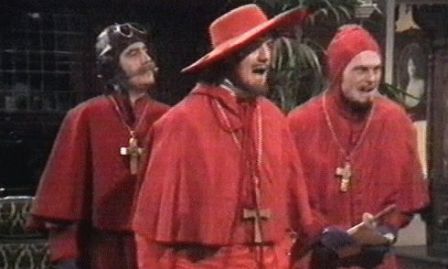
NOBODY expects the Spanish Inquisition! Amongst our weaponry are such diverse elements as: fear, surprise, ruthless efficiency, an almost fanatical devotion to the Pope, and nice red uniforms...

Yesterday, I taught a church history Sunday School class on John Wesley. As I prepared it, and even as I taught it, some things finally came together in my mind. The relative youth of the New Calvinism is leading to a fair amount of immaturity among new Calvinists, which is unfortunately stoked by crude caricatures promulgated by older Calvinists.

This unhelpful trend is fueled by Radio discussion programs that are one extended snarky, smarmy inside theological joke (wink, wink, nudge, nudge, know what I mean), the oversimplified view of Arminianism as if it were one monolithic Pelagian heretical movement, etc etc ad nauseam.

The great danger of this is when younger believers or the children of the young Calvinists start to peek behind the theological curtain, and, to mix a metaphor, begin to see that the emperor has less clothes on than heretofore thought. It is this, I think, that is partially fueling the "progressive" party of the PCA, pressing men really out of evangelicalism, and I repent for whatever part I have played in that in the past.

The straw man will not, I pray, be the death of the resurgent Calvinism. I am praying that our better lights prevail (and I would put Piper at the head of that list, but also Mohler, Ferguson, Keller, and Begg). These men are moderate in the right ways, have the wisdom of age, and understand how to keep the primary things primary. The test will come, I predict, when the movement is in the hands of younger men.

What we need is a warm-hearted Reformed evangelicalism, such as Murray describes in his book The Old Evangelicalism.

And, thus the importance of theological self-critique. I have not one doubt about the Reformed faith. I have many doubts about how it is practiced, enforced, and held, as if we had the right answers not only on theology, but also practice, and were doing a fantastic job of reaching the lost and engaging the culture. And, it is practice where we fall far short --a serious sin.

Why do we not have the missionary fire of the early Moravians? Why not the blessed kingdom productivity and zeal for good works of the early Methodists? Why are we not able to bridge racial, cultural, and economic divides like the Pentecostals?

Perhaps, I think, because we spend so much energy critiquing these folks, sneering down our theological noses at them, making circular, nonsensical arguments their positions (particularly continuationism), wrongly pegging Wesley as if he were a Pelagian, and dismissing the Moravians and their one-hundred-year prayer meeting, simple lifestyle, openhanded generosity, and fervent holiness as "pietism."

The Reformed world needs to wake up. We are so dead, and I doubt we even know it. We love to be right, and are satisfied with our rightness. Most of our efforts are aimed at self-preservation. The activities of our courts, and our boundary markers are excessively punctiliar. All our effort, it seems, goes into procedure and organization.

We would do well to heed this counsel from Wesley:

What is the end of all ecclesiastical order? Is it not to bring souls from the power of Satan to God? And to build them up in his fear and love? Order, then, is so far valuable as it answers these ends; and if it answers them not it is worth nothing. Now I would fain know, where has order answered these ends? Not in any place where I have been: not among the tinners in Cornwall, the keelmen at Newcastle, the colliers in Kingswood or Staffordshire, not among the drunkards, swearers, Sabbath-breakers of Moorfields, or the harlots of Drury Lane. They could not be build up in the fear and love of God while they were open, bare-faced servants of the devil.”

But maybe it's just Monday.

Wednesday, December 16, 2009

Richard Wurmbrand on Preaching

Maybe an antidote to much evangelical preaching? Wurmbrand suffered 14 years of horrific torture for Jesus, more than half of it bereft of light, sound, or contact with other humans. Yet, his love for his captors led many of them to Jesus.

Here's what he says about preaching:

Some tell me "Preach the pure gospel!" I don't know what this so-called pure gospel is. Was the preaching of John the Baptist pure? He did not say only, "Repent, for the kingdom of heaven is at hand!" (Matthew 3:2). He also "rebuked [Herod]...for all the evils which Herod had done" (Luke 3:19). He was beheaded because he didn't confine himself to abstract teaching. Jesus did not preach only the "pure" Sermon on the Mount, but also what some actual church leaders would have called a negative sermon: "Woe to you, scribes, and Pharisees, hypocrites!...Serpents, brood of vipers." (Matt 23:27, 33). It is for such "impure" preaching that he was crucified...Sin must be called by its name. Communism is one of the most dangerous sins in the world today. Every gospel that does not denounce it is not the pure gospel.

Now, communism is dead in most parts of the world, God be praised. We still need to be prayerful for its victims in Cuba, Venezuela, Viet Nam, North Korea and China, and most likely to come in Bolivia. But, Wurmbrand's point is well-taken. The church must be like the prophets: opposing all that keeps men in prison for their faith, and in the Satanic, destructive clutches of deceptive philosophies.

Like Wurmbrand, we ought to hate communism (or whatever ism) and love communists.

Thursday, December 10, 2009

Christians and Twilight (or "Was not Meat Loaf among the prophets?")


On a hot summer night, would you offer your throat to the wolf with the red roses?

Will he offer me his mouth? Yes!
Will he offer me his teeth? Yes!
Will he offer me his jaws? Yes!
Will he offer me his hunger? Yes!

Again, will he offer me his hunger? Yes!
And will he starve without me? Yes!

Warning: the below is very frank...

The vampire craze is a strange one, I must admit. Teen girls and moms alike lining up with baited breath to catch the next installment of the love affair between Edward and Bella --star-crossed teens, a twentieth century pulp fiction Romeo and Juliet.

I am not writing to critique either the books or the movie. I am rather writing to talk about the differences between men and women, and how the sin of lust takes different forms in each.

We all know the seriousness of the porn empidemic. If a man does not take positive steps to avoid it, it will find him, and more likely than not, it will hook him. The reason is the way God has wired men. Men are attracted to those parts of a woman that are different than he is, those parts most specially related to the bearing of children. He is also attracted to physical depictions of the act he most desires to perform with a woman. It is (sadly) natural. It is also sinful and damning. The vast majority of men are into it --even Christian men.

And, how many women are dismayed, disgusted and hurt to find out their husbands are using pornography. They view it (rightly) as a betrayal of sacred trust. Marriages even end over it --wrongly, I might add. The man does not view it that way. He (wrongly) does not view porn as having any significance beyond physical gratification: it is a matter of mere appetite. Women understand the power and purpose of sex far more than men do. Women know, innately, that it is designed to be a powerful bond between souls, not just physical gratification.

And, this is what makes women particularly vulnerable to a different sort of porn, and that is fanciful romance. To call it porn is not too strong a word. It is equally destructive, sets up equally unrealistic expectations, and has, at its root, the same core sin of pornography --an escapist fulfillment of fantasy in someone other than one's spouse. It breeds discontent with the real nature of the male-female relationship.

Many have praised Twilight, written by a Mormon mom, for its high morality. But, on closer look, is it really moral? Doug Wilson has some good thoughts here.

Let me ask you: does the following sound pornographic? (Citing Doug Wilson):

Edward has a “musical” voice, a “dazzling face,” “flawless lips,” a “crooked smile” that is “so beautiful,” a face that was “such a distraction,” he flashes “a set of perfect, ultrawhite teeth,” and he is a “bizarre, beautiful boy.”

He has a “perfect face,” “brilliant teeth,” a “glorious face,” and, if we hadn’t made this clear yet, he had a “stunning face.”

...what with his golden eyes, his black eyes, his “too-perfect face,” coupled with the fact that he is “interesting,” “brilliant,” “mysterious,” “perfect,” and “beautiful.”

Never mind that these descriptions would make Miss Austen faint, and give even Margaret Mitchell a toothache.

I ask you, ladies, as moms of girls, is this what you want your young women seeking in young men? How is this any less salacious than a young man who is attracted by female body parts? We routinely tell boys not to objectify women, to look at a girl's eyes, and not down, etc. All this we ought to do. But women are no less sexually perverse than men. Men fantasize about sex, and women fantasize about sexual romance. Men want women, and women want men to want them.

The Christian woman ought not have an easy conscience about this. We would discipline a group of men who went out to a strip club to see a hot new dancer. But, how many husbands dare question whether a group of women ought to go see Twilight?


...And does he love me? Yes!

Yes! On a hot summer night would you offer your throat to the wolf with the red roses?
Yes! I bet you say that to all the boys....

Monday, December 7, 2009

What Ought Preachers to Harp On Today?

At least in the Southeast...

The burdens of preaching to our present day:

1.) Uphold Christ in his all-sufficiency, but don't misuse the doctrine. I sense some are taking "Christ-centered" to the extreme, and not challenging enough our comfortable lifestyles. "Why do you call me 'Lord, Lord' and do not the things that I say?"

2.) Put forth the Trinity in its relational dimensions. We are created for relationship with God and others because God is inherently happy among the three persons, and has his completion in the fellowhsip that exists in himself. That happiness overflows to us, and draws us in.

3.) Spend relatively little time preaching against the ills of the culture, and the sins of others, and relatively much time preaching against the idols of those in front of you. The cultural mandate does not mean telling people for whom they must vote.

There are idols in conservatism and liberalism.

Political Conservatives tend to think that as long as I have all the right moral positions, and obey the law, I can make as much money as I want and spend it on myself. Jesus says no.

Political Liberals tend to discount the de-humanizing force of cyclical dependency. If a man will not work, neither shall he eat.

Jesus has things to say to both groups. Unfortunately, churches full of conservatives tend to hear sermons bashing liberals, and churches full of liberals tend to hear sermons bashing conservatives. This is completely backwards.

4.) Keep people from being satisfied with too-easy answers, and cast them on Christ, instead of their own efforts.

Some people really think that if I homeschool my children, do everything right, etc, the product will be young Christians. This is not reliance on grace or constant reliance on Christ. Others think mastering doctrine or church practice or whatever will result in a life pleasing to God. What God wants is reliance, in the first place, not on what we do, but what he is done. Don't give people refuge in good things that fall short of the main thing --which is reliance on Christ.

5.) Teach them that holiness means following Christ, not just adherence to a list of requirements.

The whole idea that a decent, lawkeeping life is the same as following Christ denies the nature of the New Birth. The Spirit moves about as he wills, like the wind, so does everyone born of the Spirit. All our life is one of discipleship --following Christ. His Lordship goes far beyond a list of Ten don'ts and do's. That is kindergarten spirituality.

6.) Emphasize the power of the present ministry of the Holy Spirit.

Reformed people don't think about the Spirit much. Could that be why his power is so lacking in our churches? Preach him as an undergirding to every message. Make people aware of the power that is available to them by his indwelling.

7.) Teach the spiritual value of a moderate, uncluttered, simple lifestyle. Do not let people be comfortable in a moral, affluent lifestyle while people are going hungry. As Piper says, "Tell them they don't need gold, when copper will do."

8.) Teach them to train their children, but not idolize them.

God, and not activity and accomplishment, should be at the center of family life. Do not think your children need every experience --what they need is your time, interest, and love, and Jesus. Don't ever say or think "I did everything for you, or gave you everything." That's a sure sign that you have denied them the one thing that God requires of you: that you give them relationship with yourself, and lead them to Jesus' feet.

9.) Keep them aware of the spiritual war that is happening all around and within them.

Again, Reformed people tend to discount spiritual warfare. I've seen Satan too up close and personal to discount him. There is a war within and without. Awareness of it leads us to cast ourselves constantly on God, which is the point, I think.

10.) Promote an evangelical catholicity.

News flash: Reformed people tend to be narrow. They don't like to read those they may disagree with. This harms us. Teach people to read with discernment, and then point them at Lewis, Wesley, Tozer, Newbigin, Bonhoeffer and others. Likewise, teach them that Reformed people aren't always right. Disagree with Mike Horton and RC Sproul. It's good for you and them (your people, not Horton and Sproul).

11.)Teach them that holiness is an indispensable quality.

Sometimes Reformed people react too strongly against moralism, and seek safe harbor in antinomianism. The Higher Life types are wrong about much, but they are right about this: the Christian is not always and only to be a perpetual failure. Frankly, I am tired of myself and others always only confessing failure, and never seeing victory and transformation. Schaeffer tired of this too --read True Spirituality. I agree with Schaeffer! Ravi Zacharias said the one puzzle he cannot make any sense of in all existence's great mystery is this: why the gospel doesn't often deliver the transformation it promises in himself or others. I agree with Ravi. Chesterton said the one objection most people have to Christianity is Christians --I agree with Chesterton.

What else should preachers emphasize?

Thoughts on Preaching for Preachers and Listeners

One of my favorite topics is preaching, and how it's to be done and heard. It's valuable for listeners to hear preachers think out loud about preaching and respond.

Preachers can be stubborn and overly sensitive about preaching. Understandably so, since hopefully the preacher is pouring his whole self into the exercise. If he isn't, he ought to go work as a mid-level functionary somewhere.

So, just some points to consider.

1.) We ought not to give up on preaching in our multi-sensory age, but neither ought preachers to underestimate how listening and processing information has been changed by media exposure. The spoken word is not dead and can still hold the attention. We are exposed to infinitely more verbiage now than ever before, and probably can process more information more rapidly than previous generations.

What we find difficult to do is to hold on to sustained logical and rational argument. We can lament this fact, and long for the good old days, or we can adapt to it so that we are heard. I prefer the latter.

The best compliment I think I ever got on preaching was from a mid-teenage boy who visited a few times at one of our churches. The mother of the girl he was seeing said, "He said he has never understood any other preacher, but he understands you." This is not because I dumb things down, but more because my own scattered brain leaps from topic to topic, addressing one issue from multiple sides, and trying to utilize some recapitulation of major ideas. I find this more difficult to describe than it is to do.

A fuller description of it can be found in Fred Lybrand's Preaching on Your Feet.

A closely related second point is:

2.) The Greco-Roman rhetorical form is dead, and good riddance to it. In popular parlance this is "three points and a poem." Formally it is: proposition and supporting sub-statements. Thanks to Fred Craddock and his fine little book As One without Authority for pointing this out. In case you haven't noticed, the Bible isn't written this way.

Unfortunately, expository preaching, in desiring to be a servant of the text, too often views the text through the lens of rhetoric. Craddock says: don't just preach the content of the text, but let the text provide the form, and the impact of the sermon. It is hard to unlearn old habits, but being true to Biblical form and impact is being true to the text, and tends to build interested listeners, too.

2.) Preaching needs to be a bit raw-edged. My mentor passed on what his mentor passed on to him, "It's no sin to be interesting." I would hasten to add it is a great sin to be boring! Preaching should be a bit raw. This doesn't mean it must be loud (though it can be). But, it is a whole person endeavor, and sometimes that is less than polished and refined. What it is, is real. This is why, I think, younger people are flocking to listen to Mark Driscoll and Francis Chan. There is no mollycoddling in what the say. For all their faults, the younger generation are tired of plastic imitations of reality that so satisfied their parents. They will take the truth straight up, thank you very much.

But, if you preach raw, baby boomers will be the ones to complain. Those who sought out the PCA because they loved Reformed arcana do not like their lives, priorities and comfort challenged. Many of them have not met Christ, but believe him to be merely a set of propositions, not a Divine Person (about whom propositions are true) whose white-hot living presence will inevitably drive out impurities. You can see the disconnect between their faith and life in the faces of their children, sad to say.

3.) Throw away your notes. Do it now. Nobody cares about your precise wordings, least of all the Holy Spirit, who longs to use you and all your hard work, but to free you from your love affair with your own words. Nobody ever commented, "I don't think he used his notes enough." It took me 12 years to do this. Do it now.

4.) There is no one style. A great preacher can be voluble, or soft-spoken, he can be brainy or relatively simple. I find myself profiting more and more from a variety of styles.

It used to be (confession time) I would mock the preaching of men like Ben Haden --not expository enough. Now, it almost brings me to tears.

Jim Boice preached like he was reading out of a commentary, but the Holy Spirit used it to great effect.

John R. de Witt scales the rhetorical heights, and set truth on fire with pathos and fervor.

Sinclair Ferguson is quiet and gentle, and yet tears the heart to bits.

A certain Manhattanite I shall not name preaches erudite, doctrinal, and Christ-centered sermons in a way that gains a hearing among post-moderns. One of the most memorable sermons I ever heard was him preaching on Abraham interceding for Sodom as a model of imputation. All of these men are preachers in the grandest sense, and all very different.

Another post to follow on what sorts of applications I think ought to predominate in preaching today, at least in my cultural context.

Monday, November 30, 2009

Life Together

Dietrich Bonhoeffer's lesser known (than The Cost of Discipleship)but equally profitable book Life Together speaks of how Christians are to get along with one another in the church, not with illusions of everything being in perfect accord all the time (for we are sinful and short-sighted), but rather the beauty and benefits of struggling within the bonds of love.

So, both Tim Keller's comment on my last post, and a moving sermon on the gospel in the midst of relational conflict by Scott Roley(Christ Community, Franklin, TN), have got me thinking about this.

There was a lot of conflict in the early church. We see it in Acts on how the Gentiles were to be incorporated into the church, and the disagreement between Paul and Barnabas over John Mark. Corinth was fraught with conflicts over personality and false teaching. Galatians mentions the conflict with Paul and Peter.

The church does not do conflict well. The Scriptures lay down clear teaching on how to deal with conflict, both in situations of interpersonal offense, and in situations of false teaching or false practice.

Having grown up in the mainline (Reformed Church in America) and coming into the PCA, I thought it was a city set upon a hill. But, what I realized is that though there are significant sins of liberalism, the sins of orthodoxy are more heinous. A radical statement that! But, we are accountable for the knowledge that we have. My friend J. R. de Witt used to talk about the sins of dead orthodoxy a lot --and I have experienced them firsthand. A cold, censorious, judgmental and narrow spirit, a lack of compassion and brotherly love, a hidebound insistence that one's own way is THE WAY, anger, consumerism, Spirit-quenching, and cathedral-building (yes, I know, I hate Reformed cathedrals --they are sinful in an age of poverty and hunger, sorry people, but it's my blog).

And I say again: these are far more egregious than the sins of the mainline, simply because we ought to know better. IF we have the Holy Spirit, then why isn't he more manifest?

I have to note that: a.) I am incredibly guilty of everything I say above, except that I haven't built a cathedral (yet). b.) these sins are no respecter of party in the PCA, but seem to me to be equal on all sides. Each party has its jerks, and all of us are jerks now and again.

The danger in our post-modern context is multi-form. One of the chief dangers is confusing persons with arguments. This happens in two ways: either my opponent in an argument is my opponent in life, and therefore not only mistaken but evil, or at least stupid, or, that an attack on a person's position is an attack on their person.

We need to understand that Satan loves to push us to both of these poles. I have both experienced each of them, and been guilty of them in debates in the church. Both of them hinder understanding, and the advancement of the truth. Both of them leave lingering resentments.

We also have a false understanding of unity that says it means we must be in complete conformity of opinion and practice all the time. Disagreements and disputes ought never to arise among a family, or the people of God. This is conflict avoidance, and it hinders the triumph of truth.

So, I don't know how to do this. But, I know it's crucial that we do it. We need to find ways to deliberate and debate without horns and without teeth. We need to understand that good men may differ.

But, the most disheartening thing of all is that I have never seen a minister challenged on the grounds of his deviating from the truth who has been humbled, confessed his sin, and returned to the straight and narrow. I have seen men who have sinned in their behavior broken and contrite, and returned to the fold, but I have yet to see a minister chastened as to his beliefs and teachings who humbly confessed, and returned. I believe I have a pretty good grasp of church history, and even there, I can find no examples of a man whose doctrine was challenged, who admitted he was wrong. Surely someone in the course of the history of the church has indeed been wrong, and been humble enough to admit it!

So, how do we debate, discuss, and rebuke in the church? It's Monday, and per usual, I have no answers on Mondays, only questions :-)

Tuesday, November 10, 2009

What Will You Do While Your Straw Man Burns?

First, credit where credit is due. Thanks Ben Kappers for getting me thinking about this.

The great danger in any "inner ring" is that we talk to ourselves, and thereby become firmly convinced that we are right, and the other guy is not just wrong, but stupid, evil, and a bum.

There is a great danger of this in the gospel ministry. Our friends, sad to say, are all people who think pretty much like us. Even in the ranks of ministers in a denomination with a common and heavily-enforced statement of faith, we subdivide into particular camps, and rarely are friends with the "other guy." There are twin sad results. One is, our rationales for our own positions are weaker than they need to be. The second is, we fail to love the others, and become prideful of our own opinions.

How this might be handled in the church (where reproof, standing up for truth and correction are necessary things) is a subject for another day. The topic for today is the world.

So, a ministerial student or other ardent young Christian has been taught in his Jesus incubator that all atheists are not only wrong but stupid, angry, selfish people, that all homosexuals have deep personal issues, that all secularists and statists are just self-interested fools.

Then, God, in his good providence, puts them in contact with the world. And maybe they meet a real, living atheist who feeds the poor, is kind and generous, and doesn't care much that you are a Christian, if it works for you.

Or, he meets a homosexual who is a decent person, no more "flawed" than he himself is, and pretty likable, diffident, and humble.

Or, he develops a friendship with a liberal who really does think that government is the answer to the worlds problems, and is a sincere, devoted friend.

What then? His whole paradigm crumbles. Sometimes, he starts to question everything he's been taught. If those who taught me are so seriously wrong about this, what else in my world-view is wrong?

I think of two models in this regard. One is my mentor who maintained a close friendship with the atheist minister of the prominent self-described "liberal" church. This was no mealy-mouthed liberal, but a fiery, strong, and very intelligent man, as my mentor is. Yet, they respected one another, loved one another, even as each was firmly convinced of the other's error. The bond was love and respect, not agreement of opinion.

The other model is a pastoral friend in Western North Carolina who, for years, has carried on productive dialog with local abortionists. Does he want to change their minds and practices? OF course he does. Why? Because he loves them as much as he loves the unborn, I suspect. Are they murderers? Well, so am I.

And, this is something we in the church need to learn. Nobody out there is any more particularly evil than we ourselves are, by nature. A homosexual is not a worse person than I am. A liberal is not necessarily mean and nasty --some of them are far kinder and more generous than many who can rightly state every Biblical doctrine.

The point is not that we should abandon our beliefs about any of the above things. The point is that we should love people, even as we disagree with them, and try to understand them. The old principle of debate, so neglected in our current practice, among my own "party" in my own denomination is instructive: know your opponent's position so well, and be able to state it accurately in a way he himself can affirm.

And then love him. Respect him as a fellow creature in the image of God. The only difference between him and you is not you. The only difference between him and you is that you believe in Jesus, and he doesn't. Or, he does, but he doesn't quite see the full picture. Then, ask yourself, "Is it possible there are places where he sees more clearly than I do?" I may be right about morality, but he may be right about generosity of spirit and wallet, for instance.

Our church culture needs to change. We need to know unbelievers, love them as persons, and show Christ to them. We ought not shy away from giving the cause for Christ, but it must be done out of humility, love, and respect.

Why? For we are no better, no better, no better....And such were some of you, but you were washed...Did you wash yourselves? Did you make yourself clean? Did you rescue yourself from erroneous opinion and sinful practice, or did Jesus do that for you? And, if Jesus did that for you, then why don't you think he won't do that for someone else?