Wednesday, February 16, 2011

An Excerpt, with Commentary


A Sermon about Sermons that Get Preachers into Trouble, which Got Its Preacher into Trouble.

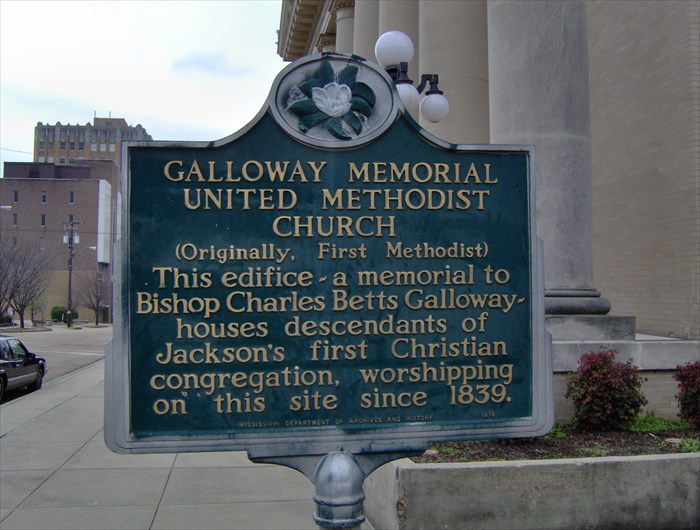
No, not me, but it certainly got me thinking. This is excerpted from a sermon included in the fascinating book (long out of print) Agony at Galloway. If you are from Jackson, you will know that Galloway is the title of the large, socially-prominent United Methodist church in the center of our fair city. You may know too that, perhaps more than any other, Galloway tore itself apart during the Civil Rights Era. Her long-time minister, the legendary Dr. W. B. Selah, resigned his 18 year pastorate. Why? Because Galloway, like white churches throughout the South, decided to station guards at its doors to bar African-Americans from coming to worship.

His successor, W. Jeff Cunningham, wrote the book, and sacrificed his career, like many of his fellow Methodists, during that sad time.

I note from the top this is not an evangelical sermon. It doesn't have a whiff of evangel about it. It is not, in that way, the sort of sermon we should preach. Sad to say, in Cunningham's day, evangelicals were on the wrong side of this issue. It is, however, a heroic sermon about sermons, and thus merits our excerpting:

If We Sound No Trumpet: A Sermon Preached in the Crisis
Eze. 33:1-7

To look at these words in their historic setting, Ezekiel is in Babylon along with the flower of the Jewish people, carried there into exile by a military conqueror who had crushed his country and would leave Jerusalem the haunt of jackals...Here the Jewish people are surrounded by the allurements of the magnificent civilization that is Babylon, the world's capital, a pagan culture made glorious by everything wealth and military power can bestow....With all the freedom to come and go as they please, they are expected to become absorbed in the culture of Babylon, to forget the ideals of their own race and religion, to join in the worship of the gods of Babylon, and to increase the prosperity of the realm. The strong temptation every Jew feels in Babylon is to go native. And some go native with a vengeance. They forget their own country, they forsake their former faith and loyalties and lose themselves in the exotic culture of this luxurious land.

It was in this critical time that Ezekiel spoke the word of God and became one of the towering figures of all time...With the nation facing the threat of moral decline, the Lord says a watchman will be set up..."if this watchman sees danger coming and blows the trumpet and warns the people; then if any one hears the trumpet, but will not heed the warning, when he is destroyed, his blood shall be on his own head..."But if the watchman sees danger coming, and does not blow the trumpet, so that no warning is given, and the danger comes and destroys, then, says the Lord, "his blood I shall require at the watchman's hand."

Now if we take these words out of their setting in ancient Babylon, they have meaning that walks right up to the doorsill of our own consciences here in Jackson..He commands us to blow the trumpet and warn the people when there is danger.

One thing that makes this particularly important to consider this morning is the charge that the church ought to stay out of politics. "The church ought to stay out of economic and social questions," it is said. "The church has no business making pronouncements on this temporal matter or that."

But listen. The church cannot stay out of anything God wants in on. And God wants in on everything that concerns people --their moral habits, their social customs, their business practices, their handicaps, their day-by-day relationships...God has an absorbing concern for everything that affects the lives of people, whether it is politics or business or sport or education or any other human enterprise. And the church must be concerned with anything that concerns God.

Those who say the church ought to stay out of politics do not know their Bible, or have forgotten it...Amos is a collection of sermons by that fiery man who spoke for God to the people about the things they were doing. He was critical of the government. He talked about people who got drunk. he talked about social climbers. He talked about merchants who were dishonest in their business, using false scales in their buying and selling. He talked about people who lived in luxury while others around them were hungry. All this didn't go over very well.

The people glorified their religion in ornate observances. The priests wore gorgeous robes, the choir sang lovely anthems, and their altars were laden with choice offerings. But they did not want their religions questioned at the point of its moral quality. They did not like to be told of the relationship between religion and their daily practices in politics and business and society...They said to him, "Prophesy to us of pleasant things"...Men inveterately like to hear smooth things said to them, how right their attitudes are, how genteel their inherited traditions are; and if all this can be said in the name of God, so much the better...

When someone says preachers ought to stick to the Bible that's exactly what most preacher, I believe, want to do; but when they stick to the Bible, see what they find. They find prophets majoring in politics and measuring every exercise in government by the will of God....In the Bible we see a long line of prophets standing before kings and denouncing their policies because those policies were not righteous...These are men who sounded a trumpet, warning of danger, critical of monarchs for their unrighteousness in the affairs of state, and demanding that they order their affairs in line with God's purpose.

[relating a story of a minister in another city, supported by his board when under fire] "We stand for a free pulpit in a free church. We do not expect or desire a minister simply to echo the opinions of the congregation..." When we claim to be a church, a trumpet is placed in our hands. We are to sound this trumpet to warn the people when we see danger --and by danger is meant anything in our attitudes and practices which Christ cannot approve. If they do not heed the trumpet and die, their blood is on them. But if we see the danger and sound no trumpet and they die, then their blood is upon us...

...The church is not supposed to echo the opinions of the status quo. The church is supposed to stand above the status quo to challenge it, to hold before it a standard, to demand that every order of society conform to the ideas in the Sermon on the Mount. We are not supposed as Christians to bring in ideas from the outside and try to make the church conform to the ideas we have brought in from the outside; we are supposed to take the ideas of the Sermon on the Mount out of the church and into the organizations we belong to and measure those organizations by the way they obey Jesus' moral demands.

The preacher in the pulpit is not supposed to reflect the majority opinions in the pew and no good layman expects him to --he is supposed to hear the voice of God and make that voice heard in all the affairs of men whether it makes them comfortable and contented or not....

We Christians are not supposed to make religion over into what we want it to be until it fits our lives. We are supposed to change these lives of ours until they fit into Christ's way of love and service which He lived so beautifully and so simply.

...Some have said the church ought to stay out of controversial fields. But the church that never handles controversy never handles Christ. If the church tries to keep her hands clean, she will stand before the Lord with her hands empty. Id the church never expresses a conviction except where a unanimous vote has already been given, the church will never have a word for needy and dying men. If the church chooses her words so carefully that no one can object, she has missed the spirit of the prophets who were stoned because they spoke so clearly for God and the spirit of Jesus, whose truth led him to a cross.

I can hear objection to what I am saying, that in all this I am overlooking the gospel of personal religion, that religion is an affair between the individual soul and God...It is the root of religion, but it is just that..it is not the fruit. The fruit is seen in the way we practice our religion out in the world where we live....

The end of the sermon. Jeff Cunningham lost his job over this sermon. As he was leaving, Galloway rescinded its all-white policy, and opened its doors. He was sacrificed and the truth triumphed. Would that ministers today would be so bold.


Tuesday, February 15, 2011

Gossip

Gossip is relating news, true or false, about another person, with an implied or stated judgment about the person's character.

This is one of the most powerful scenes in cinema, from the movie Doubt. Watch it. If you've gossiped, consider repenting to the person against whom you've gossiped.


Monday, February 7, 2011

What answer would you give?

When Empathy Isn't Enough


Coming to Terms with a "Bad" Demographic Hand

We are an almost-all white church in the midst of a predominantly African-American City, in the weird position of being "Majority-Minorities" --18% in fact, by recently released census data. Jackson is 80% African-American, and I am as white as God made white folk. Our worship is as white, vanilla Presbyterian as one might expect from a fifty year old mostly-white congregation.

18% and not headed towards 19%, if you get my drift.

I am at two distinct disadvantages on the topic of race. First, it is really hard to be white and talk about race. Second, it is really hard to be Northern and talk about race in the Deep South.

Let me say from the first, from my white Yankee vantage point, racism in any meaningful sense is not an issue among our church. Trinity has been integrated in the past, and we have a few African-American members and visitors, and they have told me again and again how loved and accepted they have been by the congregation. One of them says, over and over again, "These people are my family." Another says, over and over, "I feel so loved at Trinity." These things warm the cockles of this pastor's heart.

The census data do not show, however, a larger troubling trend. It is not just that whites have largely left Jackson. African-American families that have the means to leave, are leaving too, to Rankin County, by and large, where schools are good and streets are safe. It's not wrong to want those things.

Our suburban congregations are burgeoning. First Presbyterian, the mother church of local Presbyterianism, remains several-thousand strong, with excellent preaching and teaching. A few of us are caught in between First Church and suburbia. Demographers would call this an undesirable thing. Praise God that Jesus is not a demographer.

Humanly speaking, we are at what demographers would call a "disadvantage." A white church in a black city. A wealthy church surrounded by poverty. An educated church in an area blighted by educational breakdown.

We are here by God's grace, and his plan. It would be an easy thing not to be here. Yet, as Piper says, God calls the Christian to move away from comfort and towards pain. But, I'm tired today, and I don't really want to move towards the pain all the time.

It is not always easy to see what this looks like. What does it require of us? Placing our children in failing schools? It is hard to see how that would be a good thing. We can work for a brighter day when people could live in the city and be involved in the schools in an incarnational way, but I just don't see it happening in the current mass bureaucracy of the Public Schools. We need parochial schools or charter schools or something that would serve as an option for parents of whatever income level who desire something better for their kids.

So, what do we do?

First, we are here, so we minister here. This may mean no growth, and even further diminishing. Some people will continue to move where life is (supposedly) easier. Churches in neater communities, closer to home, where community life is perceived to be easier. God bless them. I, for one, am glad to be part of a church where the homeless have been welcomed with open arms. I wish that had continued, and hope maybe God will bring us some again.

Second, many of us suburbanites will continue to feel guilty for living at some remove from the issues of Jackson. I do. If I didn't have kids, I would be in this city. Yet, our guilt should not stop us from caring for the city. As the city goes, so goes the metro.

Third, we can change what we do, but not who we are, at root. Churches have a DNA. Moreover, we have convictions about why we do what we do. We can change our approach to the outside world (and approach it more) but must never think that better music, downplaying convictions, or any sort of selling out will bring about real kingdom growth.

Fourth, we strive to show tangible acts of love and mercy in the name of Christ. We do not have the luxury of withdrawing in our walls. We need to be proactive in this city. We need to reach out to those who are lost, no matter how different we perceive them to be, or they perceive us to be. We must do this, not as superiors out of noblesse oblige but rather as ontological equals who have internalized Ephesians 2, "We are no better..." We are beggars telling where we have found bread.

Fifth, we must pray that God would flourish us as his kingdom is to flourish. No, scratch that. First, we must pray. First, we must pray. Ask and ye shall receive. Are you asking God to build his kingdom in this difficult place? God is glorified in doing impossible things. Let's ask him to do the hard thing through us here.


Wednesday, February 2, 2011

The Christian, Manly Discourse and the Democratization of Information


"Your answer is now required Marcion, murderer of the truth...you utter scoundrel, who pronounce 'innocent' the assassins of God..." Tertullian @ Nicea

"O Praxeus, you heretic who has crucified the Father and driven away the Holy Spirit." Tertullian, Against Praxeus

A friend tells me that Duke University singled out the PCA for egregious offense in the internet civility department. I wish I could argue with that, but...

I find this article on civility and passion, from the other side of the politico-religious aisle, very interesting.

Here are a few scattered thoughts...

Quite frankly, I think we are living in a wimpish age. Instead of asserting ourselves strongly, and, when necessary, defending ourselves strongly, we duck and run for cover. Our fathers faced the flames singing, we wince and wail when our precious feelings get hurt. There's a lesson about American self-absorption in there somewhere.

We confuse persons and positions. Someone criticizes my positions or my words, and I take personal offense. This kills public discourse and makes correction impossible.

I am for free, full and vigorous discourse. I don't much like the Ninth Commandment flung around as a way of quashing dissension and debate. If someone mis-characterizes my position, I shouldn't cry"Foul!", which, after all, convinces nobody. Rather, I should man up and defend my position. That's what Paul did, after all, when he suffered at the hands of Corinthian super-apostles. He did it with sarcasm, too. Horrors! Paul, I wish you were nicer, like Jesus, except that time he called Herod a fox, and the time he took a whip and drove out the moneychangers. But, other than that!!

Niceness is not a Christian virtue; not when truth is at stake.

In the civic sphere, the great cultural gatekeepers do not much like the blogs. Who, after all, appointed these anonymous upstarts, often working for free, to decide what events are newsworthy? Isn't this the territory that belongs to the professionals? The big three information filters? The AP and the NY Times?

The truth is, if you control information, you effect how people think. How can they ponder alternatives they never hear? How can they process events of which they are not made aware? The major media love to decide what is important and what is not. Why do we hear about the wholesome blondes Natalee Holloway and Elizabeth Smart, but not the nameless, faceless minority youth who disappear every day? There are countless cases of gross injustice in our society: why do we hear only of a few, and these over and over, even from (gasp) Fox News? Networks cover the horror of war, but not the triumphs of war or vice-versa.

The good news is that the genie of democratized information will never go back into the bottle. Bloggers are here to stay. I think this is good, but not an unqualified good.

There seems to be a growing concern about the use of blogging within our own denominational context. This is worrisome to me.

A few random thoughts.

1.) If we are going to have free speech, we must put up with irresponsible speech. Much of what is said on the Internet is unfair, inaccurate and uncharitable. This is the price that we pay for the free flow of information. The alternative is far worse: if we restrict information, error, misunderstanding and ignorance will grow. Because of inaccuracy, each reader and writer should be careful to check his facts. In the church, we must hold people accountable for their words.

2.) Some, whose statements are singled out for scrutiny and critique, will find such scrutiny uncharitable. They will be right in some cases. In other cases, they will hind behind this defense in order to continue to propagate their errors. In some cases, they will be mad just because some people had the temerity to disagree with them.

3.) Sunlight remains the best disinfectant. The press, in the body politic, must be free to hold the government to account to the people. It is the "Fourth Estate," the ones who shine the hard light of truth on the actions of those in power, to ensure honesty and prevent against self-serving. In the context of the church, public information is crucial to hold pulpit and lectern accountable to pew, and more importantly, to Bible.

4.) Men love darkness rather than light, because their deeds are evil. We, quite naturally, want to hide ourselves. Even when our deeds aren't evil, nobody wants to be critiqued or called out publicly. It is uncomfortable. We feel foolish. Our friends rush to our defense. Ranks close around us. We feel justified in our opinions. Rhetoric increases. Positions that were soft and fluid become hardened with opposition. We have staked our ground, uncertain as it might be, and now ego demands we must defend it.

5.) We must come to distinguish the difference between "You are an idiot" (the saying of which puts us in danger of hellfire), and "your positions are wrong." This is true on both the giving and receiving end. A person critiquing my beliefs or positions is not necessarily calling me an idiot. A person articulating false positions is not necessarily an idiot, either.

6.) Love doesn't demand being squishy in our thinking. Publicly advanced positions and arguments are rightly dealt with in public forum. If I launch a salvo into the public domain, I should expect, not a private phone call trying to work out some interpersonal issue that is really unrelated to the matter at hand. I should, rather, expect a public response. Matthew 18 is not in play, as long as I haven't impugned another's character. As someone once said to me, "If you are provocative, why are you surprised when people are provoked?"

7.) I don't care how virtuous we are, we need some alternate sources holding us accountable. We know ourselves to be good men. Our motives are noble. Our intentions are pure. Our positions are right. Yet, in our heart of hearts, we know we can be self-deceived. Denominations need more than an official news agency. The actions of church courts and the positions of teaching elders need to be known. Our people need to be Berean, holding us accountable to the Word of God. How can they do this, if we propagate what we propagate under the cover of darkness? Error and false teaching flourish if nobody engages in a little truth-telling now and then.

The PCA is not immune from error, false teaching, mistakes or underhanded dealing. History teaches us we ought to expect it. It happened in the apostolic church, and we are certainly no better than they were.

Bloggers are here to stay whether we like them or not. The fault does not lie with them, alone, if what is published is false or uncharitable. Readers are called upon to be discerning, too. The truth triumphs in the open marketplace of ideas. Of what do we have to be afraid?


Tuesday, January 25, 2011

The Church on a Mission

Simple and straightforward. Certainly it is possible to critique how "missional" is often done, and certainly room to critique some of what those who coined the term went on to do, but to me what is presented here is simply Biblical...

Monday, January 24, 2011

The Social Network and Transformational Christianity

First: thanks to one of my parishioners for asking me if I were going to blog about The Social Network. We also need to acknowledge, from the first, that The Social Network is an exaggerated account of the events surrounding the creation of Facebook and its founder Mark Zuckerberg. Yet, we hasten to add, it was not exaggerated enough to elicit any libel suits from Mr. Zuckerberg!

The Social Network is a fascinating study in human nature untethered to any sort of moral obligation, and casting about in the electronic equivalent of the lawless American frontier. Though he becomes the world's youngest billionaire, Zuckerberg is presented as a man unmotivated by money. According to the movie, Facebook has its beginnings in a drunken revenge stunt an obnoxious, eccentric Zuckerberg wreaks on his girlfriend. Utilizing Harvard's existing cyber social network, and using an algorithm developed by his friend Eduardo Savarin, he erects a site where people can compare the "hotness" of girls on campus.

This attracts the attention of Harvard blue blood twins Cameron and Tyler Winklevoss. They had hatched an idea for a social network limited to Harvard, and Zuckerberg agrees to help. Presumably using their idea and funding, Zuckerberg starts out to develop "The Facebook." As is common in such dorm room startups, he appoints his friends, including Savarin, to the key positions in marketing and development.

There is no question that Zuckerberg is an eccentric genius, and he quickly becomes a celebrity at Harvard. The network begins to spread to college campuses across the nation. He meets up with Napster founder and cyber bad boy Sean Parker, and, at his instigation, Zuckerberg relocates the operation to California, where the pool of talent is larger, and hedge fund managers are eager to invest in response to the pair's audacious antics.

At the heart of the story is a gaping moral vacuum. Zuckerberg seems absolutely free of any capacity for empathy. He is unrelentingly cruel to his girlfriend, and appears to have almost an autistic detachment from her. He blatantly lies to the Winklevoss brothers, whose value to him, at least in this telling of the story, eludes the watcher. The saddest thing of all is his deep betrayal of his one loyal friend, Eduardo Savarin, who, at Parker's instigation, he writes out of the company.

Yet, there is an even deeper moral abyss at the heart of the cyber world. Zuckerberg's theory is break things in order to fix them --smart business strategy, indeed. He hosts competitions for hackers to try and take down Facebook. His goal is to be the one site that never crashes. Yet, even here we see the amoral world of the cyber genius. The cyber genius, in this case, is not motivated by success, or rendering a service, or any larger moral good (though we need to note that Zuckerberg himself has either changed in this regard, or is better than he is portrayed in the movie). Sean Parker's goal with Napster was to take down the record industry, even as he protests this will make music better (if that is the case, it hasn't happened yet). We see this in the broader world, as global financial systems and missile defenses are subjected to relentless cyber-attacks, from the relative safety and anonymity of obscure cubicles.

The whole story is told through the eyes of the deposition as both Savarin and the Winklevosses sue him for their rightful share of the Facebook fortune. In this retelling, Zuckerberg remains the genius whose real motives are elusive. He claims not to care about money. He does care very much about reputation. He winds up sacrificing reputation to make money. His motivation for his betrayal of his friend and his early backers remains shrouded in the mystery of his detached character.

All of this has me thinking about how Christians function in relationship to the world. I have the honor of speaking at a conference on this very subject this weekend. There is a rising cry in our circles to remember that we are aliens and strangers in this evil world, and all that exists is destined for fire. I would certainly affirm that the Bible teaches we are pilgrims and aliens here. Yet, and at the same time, this is God's world, and he calls us to think and act as Christians in the broader culture. He brings glory to himself as his people seek to honor him in whatever their hands find to do. Locally, we have a stunning counter-example to Facebook, albeit on a smaller scale. This is the story:

To help pay his college tuition, Joel Bomgar began working as a field network engineer for a Jackson, Mississippi-based systems integrator in 2002. When not in class, he could be found driving around the Jackson area in his 1979 Buick LeSabre providing IT support to local businesses. Often, the non-billable drive time in the air condition-less LeSabre took longer than the actual service calls. It didn't take long for Joel to realize “there had to be a way” to spend less time driving in the Mississippi heat and more time solving his clients' problems.
Unable to find an existing solution that would allow him to access and manage his customers' computers over the internet, Joel decided to take matters into his own hands and develop his own technology.

Although he was still working his way through college, Joel spent many late nights coding and eating pizza to develop a functional remote support solution. Leveraging the solution he quickly doubled the number of customers he could support and cut his rather uncomfortable drive time in half. His new technology was paying off. The instant success led him to believe there might be a market for his creation, so he made up a product brochure, launched a static web site and waited.

Much to his surprise, his wait was short as he quickly began receiving calls and orders for the product. After making $24,000 in less than two months, Joel was convinced he had uncovered a significant market opportunity, but knew he could not capitalize on the opportunity alone. He soon enlisted the assistance of two friends and fellow Resident Assistants from school: Nathan McNeill and Patrick Norman – both of whom he knew were smart, hard working, dedicated problem solvers.

The trio knew little about starting a business but decided that they could, and would, make it work. Joel continued writing code and handling customer calls, Nathan focused on sales and support, leaving Patrick to focus on marketing. In the first six months after they graduated in 2003, these remote support pioneers used 90 lines of code, a one page web site and a simple keyword campaign to grow revenue from $0 to $100,000.

Determination and Innovation Pays-Off
Bomgar's founding trio has since successfully lead the company from a dorm room project to an industry leader. They credit the success to a discipline of focus and a set of core values based in Biblical principles. Bomgar is recognized
by industry analysts, professional associations and industry publications for its award-winning Enterprise Remote Support Solution – a solution which has fundamentally changed how companies around the world deliver remote IT support.

Could there be a deeper contrast between the ways of darkness and the ways of light than the difference between Zuckerberg and Bomgar? The story itself is one repeated countless times in the computer age. What makes it remarkable is the Christian men at the core, determined to live Christianly in a secular age, and in the midst of an industry noted for its moral inhibition.

Bomgar does not discriminate against non-Christians, and operates within the admittedly-restrictive boundaries of pluralistic law. Yet, it is unashamed of stating publicly how its corporate culture and values are shaped by Biblical precepts. You can see those principles here.

It strikes me as exceedingly strange that anyone would argue this is a bad thing. Yet theologues are notorious for taking obtuse and cantankerous positions. I, myself, am grateful for Christians endeavoring to do whatever they do to the glory of God. As Eric Liddell's colleague in Chariots of Fire told him, "It says in the Old Book, him that honoreth me, I will honor." Indeed.