Friday, August 3, 2012

Of Chickens, Christ, Law and Gospel


Too much has been written on the controversy over Chik-Fil-A scion and exec Dan Cathy's comments about traditional marriage, and the support of Chik-Fil-A that was rallied yesterday.  So why not add more?

Except, I simply want to consider it from one angle, and that is from this question: Do we expect the world will be more friendly to the gospel than it is to the law?

It's a hot topic for debate --how should the Christian interact with the unbelieving world?  Should he do it with law or gospel?  Myself, I don't think we can generalize.  Jesus used law where people's hearts were hard and self-righteous, and they had to be shown they were sinful (like the Rich Young Ruler).  Jesus used gospel where people's hearts were already broken --they knew they were sinners, and they needed grace.

But, the meme that seems to be current that troubles me is this:  If only we (or those) stupid evangelicals understood that if we showed (or spoke) the gospel instead of standing up for traditional marriage, then maybe secularists would know we're not hateful, and they'd accept us, and we'd get invited to their parties like Jesus did, and we would be able to bring the gospel to them sans the offense.

Now, this is not about whether or not boycotts or rally days or political action, or buying chicken or portly former Arkansas governors of the left or the right.  That is an issue for another time, and it's been exhausted.

It's an issue of whether or not it's true that the gospel is somehow less offensive than the law.  There is no question that the law can offend.  People who are flagrant violators of the law are offended by the law.  But, pretty decent outwardly moral people like the law's message which is "do this, and live."  Salvation by decency.  Very doable, very nice, and nice people can do it.  Moral, respectable people can do it.  Or, they think they can.

The truth is, whether we lead with gospel or law, we are going to be offensive.  The gospel is more offensive than the law because it hits humans at the point of pride.  "Do this and live" stokes pride.  "You can't do it no matter how hard you try" slaps pride down.  We don't like it.  I don't care how degraded a person is --by nature, we don't like the gospel.  It is only by grace that we come to like, and then to love, the gospel.  The gospel shows me who I am, and I don't like that picture very much.  I'd rather not look in that mirror.  But, the gospel doesn't leave me in the crumpled heap of an accurate self-assessment.  It shows me a savior who is God himself, who died for me, not just so I can go to heaven when I die (which is a grand thing) but so that I can be restored to that original dignity for which I was created --not the mess I have made out of it.

So, think Chik-Fil-A is gauche.  It's okay.  Think that all the Christians who supported it are misguided or whatever.  But, don't kid yourself in thinking that if Chik-Fil-A, or you or me, or the coolest hippest pastor out there, led with gospel instead of law, he'd get the love of the world.  If the world hates you, it hated me first.  That is from the lips of the walking Gospel himself.

Tuesday, May 15, 2012

Some Thoughts on Same Sex Marriage

I think it's important to state from the top that the Bible teaches that marriage is between one man and one woman for life.  Things can happen that break that bond, but the standard remains. In Matthew 19:5 (ESV) Jesus said, 'Therefore a man shall leave his father and his mother and hold fast to his wife, and they shall become one flesh'?  So they are no longer two but one flesh. What therefore God has joined together, let not man separate."  Homosexual activity and marriages are therefore sinful.

How should we approach this issue?  First, we need to understand what the Bible says about marriage.  Second, we need to understand that our secularizing world will not care what the Bible says, and so the arguments we make for heterosexual monogamy ought to be primarily apologetic in nature.

From the first, we must admit that the evangelical church has done a lousy job on marriage in its own ranks.  Well might the homosexual activist say that evangelicals believe that marriage is between a man, and a woman, and a woman, and a woman....  It is wrong to argue that homosexual marriage will kill the institution of marriage.  The sexual revolution and the rampant divorce that followed in its wake have all but killed the stabilizing institution of marriage.  We need to give kudos to the Roman Catholic Church on this point --they have not yielded to popular pressure or practice.  Yes, there is some hypocrisy --granting annulments and so on, but their stance remains:  the Catholic church is firmly against divorce.

Some Christians have wrongly sought to abandon any public or legal protections for the institution of marriage.  If marriage were not a government issue, then we would not be having this discussion.  This is true, but hardly consistent with a Christian world-and-life-view, which is why I say that we must come to understand marriage Biblically.

Rome is wrong here:  marriage is not a sacrament.  Sacraments are means of grace for believers and marriage is for all men and women.  It is not a private religious contract between a man and a woman, but something undertaken for both private benefit and public good.  It is good for children to be raised in two-parent homes.  It stabilizes society and prevents poverty and every study ever done bears that out.  That is an apologetic argument for why government should recognize and sanction marriages, though it does not answer the question of why  two men or two women ought or oughtn't to be able to marry.

Theologically, we understand that marriage is a common-grace ordinance.  It is written into creation itself, and not just for Christians.  A pluralistic society can never grasp this teaching, since it believes that the Bible is simply one religious book among many.   Some point out that the current institution of marriage (one woman and one man, for life) is of relatively recent vintage and that Scripture itself contains abundant examples of believers who did not follow this example.  Genesis, however, is an ancient document (roughly 3500 years old) and Jesus draws his teaching from the very beginning of Genesis.  God's original intent and design was not polygamy, though believers did certainly engage in it.  Yet, without exception, polygamy introduced grief into the households where it was practiced (the deadly rivalries between Isaac and Ishmael, Joseph and his brothers, and among the children of King David).  It did so because it departed from God's design.

Although somewhat tangential to the main case, apologetically we might argue that polygamy creates nothing but problems: rivalries among wives and among the children of different wives, and a shortage of marriageable women (since the birthrate of males and females is roughly the same, polygamy inevitably creates too few marriageable females).  Those who would argue that the federal government's interest in "traditional marriage" is relatively recent might consider that the Federal Government denied Utah statehood from at least the 1850's in large part due to the LDS practice of polygamy.  The government has long realized that it has a vested interest in promoting stable monogamous heterosexual marriages.

What we must draw from this is:
1.) God has a particular design for marriage.
2.) Departures from that design bring misery (as in the case of polygamy and divorced and unwed motherhood).

Yet, living in a pluralist society, how can we make a commonsense apologetic case for the protection of monogamous heterosexual marriage in law?  I think too often our arguments are weak.  For instance,  the "marriage is chiefly for procreation" argument is deeply flawed.  Theologically, we understand that marriage is not chiefly for procreation but companionship.  You do not have to be capable of procreation to marry.  Infertile people can marry; people past childbearing years can marry.  Likewise, the definition argument fails --it is mere semantics to argue "Well, the definition of marriage is a union between a man and a woman, therefore marriage can only be between a man and a woman."  It's a sad day when we have to resort to a dictionary to make our arguments, and definitions change over time.  We don't have an unchanging language authority.

We must understand, too, that we are losing this battle, and are probably going to lose it definitively and for good in the very near future.  It shouldn't be a cause for rejoicing that 60% of North Carolinians who voted did so in favor of protecting heterosexual marriage.  Our focus should be on the 40% who didn't.  40 years ago, that would have been unthinkable.  20 years ago, the number may have been 90/10.  

That said, it is important we make the case.  We need to make it to our own children.  The younger generations of evangelicals are softening towards homosexual practice and we need to teach carefully how we in the church are to regard homosexuals and their desire to marry.  Too often, our stance has been motivated by somewhat of an "ick" factor (conservative Christians who were unruffled when pastors in their denominations were exonerated while preaching that Jesus did not rise from the dead are leaving their denominations in droves for ordaining and marrying homosexual persons, which I find troubling).  Mark Yarhouse's book Homosexuality and the Christian is a good place to start.

Why is it, from an apologetic standpoint, that state recognition of homosexual marriage is a bad idea?  Theologically we understand --God created man and women to be together in a one-flesh, companionship, head-helper relationship.  We know that any deviation from the norm brings misery.  Therefore, we ought to want to prevent people from experiencing misery.

How do we, then, make the argument?  I think presuppositionalism helps us here --in other words, the best way to win an argument is to look for the weaknesses or inconsistencies in your opponent's argument.  You don't have to be harsh or unloving as you do this, but gently pointing out inconsistencies in his case will build the case for the truth.  Presuppositionalism is built on the premise that the truth is a coherent whole and any false system will have cracks and flaws --find those and you can advance the truth.

I think the case might advance this way.  What is marriage, after all, and where does it come from?  Is it mere social convention, or something more?   What does it mean?  Why is it significant?  Is it only an emotive response --somehow solemnizing the fact that humans have some desire to mate for extended periods of time, not unlike geese or cardinals?  Why is it a desirable state to be sought by anyone, let alone homosexual persons?  Nothing hinders homosexual men or women from living together, committing to one another for life, from engaging in  sex, or solemnizing such with a ritual.  Why is it that civil marriage is a desirable state?  Is it for tax purposes?  Is it for the right to make end-of-life sorts of decisions for a much-beloved companion?  

In short, it is generally true that the burden of proof falls upon the one introducing the novelty.  What argues in favor of the change?   If modern Western society has upheld heterosexual monogamy as the ideal for two millennia (and arguably much longer), and, moreover, this practice also prevails in the Orient, why is it so?  Is it merely an evolutionary response --that it's better for offspring to pair for extended periods?

I would hazard a guess that most homosexuals would argue that marriage is of far more significance than the benefits listed above.  Here is where the point could be pressed --but why is it more, what invests it with such significance?  How can it really "mean" anything apart from its religious moorings?  And how could it mean anything if those religious moorings are just made up?   What is it in us that makes us desire a relationship that causes so much pain, is so unstable, calls for so much self-sacrifice, and so often fails?  

I am just putting this out there.  I don't know how strong it is, really, but I have yet to see it tried.  We must realize, however, that rationality doesn't always win the day.  One could make a rational and logical case, but if another person is heavily personally invested in his lifestyle, rationality won't change his mind.  The Holy Spirit, however, just might.

Thursday, May 10, 2012

The Lord Gave, and the Lord Has Taken Away, Blessed Be the Name of the Lord

Many of you already know that my wife and I lost a baby in the womb this past week.  We discovered that the baby had died at a doctor's visit on Tuesday.  The procedure for removing the baby was scheduled for tomorrow.  In God's great mercy, that procedure is no longer necessary.  The baby came today.  I am glad that he did (I say 'he' though we do not know if he was a boy or a girl).  What a privilege it was to see him, tiny, perfectly formed, with delicate and perfect little hands, arms, legs, feet, and toes.  Truly we are knit together in the secret places, fearfully and wonderfully made.

I think the hospital procedure, while often necessary, would have separated us from the reality of what had happened.  We got the privilege of seeing him, of crying.  If the child had been a girl, her name would have been Zoe --life.  And he or she does live, before God.

Grief is such a strange thing.  There is no comparing the intensity of grief over one loss to another.  I have grieved friends and church members and grandparents, but not yet a parent, nor have I grieved a born child.  I will say this --there are different forms of grief.  Beyond that, I cannot characterize it.  It is grief and it is real, because it was the loss of a life, the life of a child unseen in life, and yet loved, both by us and by our Savior.

Our church's Westminster Confession of Faith summarizes Biblical teaching on such things this way:

10.3  Elect infants, dying in infancy, are regenerated and saved by Christ through the Spirit, who worketh when, and where, and how He pleaseth. So also are all other elect persons, who are uncapable of being outwardly called by the ministry of the Word.

A. A. Hodge, in his commentary on this section, summarizes thus:

The phrase "elect infants" is precise and fit for its purpose.  It is not intended to suggest that there are any infants not elect, but simply to point out the facts --
1.) That all infants are born under righteous condemnation; and
2.) That no infant has any claim in itself to salvation; and hence
3.) The salvation of each infant, precisely as the salvation of every adult, must have its absolute ground in the sovereign election of God.
This would be just as true if all adults were elected as it is now that only some adults are elected.  It is, therefore, just as true, although we have good reason to believe that all infants are elected.  The Confession adheres in this place accurately to the facts revealed.  It is certainly revealed that none, either adult or infant, is saved except on the ground of a sovereign election; that is, all salvation for the human race is pure grace.  It is not positively revealed that all infants are elect, but we are left, for many reasons, to indulge a highly probable hope that such is the fact.  The Confession affirms what is certainly revealed and leaves that which revelation has not decided to remain without the suggestion of a positive opinion upon one side or the other.
The judge of all the earth will do right, and we leave such matters to him.  Whatever God's disposition towards the children of unbelievers, in Christ he is our Father, and his covenant promises to be God to us and our children are sure and true.

David Dickson gives the Biblical reasons for the teaching of this section:

1.) Because John the Baptist was filled with the Holy Ghost from his mother's womb.  (Luke 1:15)
2.) Because the Prophet Jeremiah was sanctified from his mother's womb (Jeremiah 1:5)
3.) Because the promise is made to believing parents and to their children conjointly (Gen 17:7, Acts 2:39).
4.) Because of such, says Christ, is the kingdom of heaven. (Matt 19:14)
5.) Because the apostle calls children which are descended but of one parent in covenant with God, holy (1 Cor. 7:14).
6.) Because God hath promised in the second commandment, that he will show mercy unto thousands that are descended of believing parents (Exo. 20:6).

In The Help, Celia buries her unborn children among the roses.  We put our unborn child in the ground, too, near the flower garden.  A seed is not given life unless it falls to the ground and dies.  We have a sure and certain hope of the resurrection of the dead --and a body, born or unborn, young or old, is the seed planted in hope.  Earth to earth, ashes to ashes, dust to dust....but with a sure and certain hope of the resurrection of the dead and the life of the world to come.

Wednesday, May 9, 2012

Some Thoughts about Ministry, Particularly for Those in Seminary

I know two older ministers who began to write books about ministry based on their own experiences.  One didn't finish before he died, and I am praying the other will!

Here are some thoughts from me at year sixteen, with hopefully thirty more to go:


1.)    Ministry is frequently lonely.
2.)    You will be compared unfavorably to your predecessor, because you were in part a reaction hire (you had strengths where he had weaknesses).  Your successor will be unfavorably compared to you, and will likely be a reaction hire.
3.)    Preaching is the greatest, awfulest thing in the world.
4.)    It is hard to be productive when you are the one in charge of your own schedule.  Using time well is difficult, when you are the master of your own schedule.
5.)    You will feel guilty about the time spent doing the very things you need to do to be a productive pastor.

6.)    A lot of the scary myths of seminary just aren’t true (unrealistic expectations of your wife, on your time, on your children).  Usually, a church wants to love you.  You will always be held at a bit of a distance, but this is part of being in the ministry.
7.)    Be more patient about change.
8.)    But don’t be too patient about change.
9.)    Every church has a personality and a set of unwritten rules and assumptions about pastors.  Be careful not to misread this.
10.)                        It can be difficult to find ways to inject yourself into your peoples’ lives.

11.)                        Some people will profoundly dislike you, and neither you nor they could verbalize why.
12.)                        You will get very close to some people towards the end of their lives.  They will die, and you will grieve deeply.  Don’t underestimate the power of that grief.
13.)                        Understanding the expectations of any particular church is a tricky thing.
14.)                        God will often give you a few folks who serve as your surrogate family.  Develop those relationships and be grateful for them.  Sometimes these people will eventually pull away from you, and you will be reminded again that one of the costs of ministry is being separated from your family.  Let this help you long for heaven.
15.)                        You will discover ugly ambition in yourself and it may show itself in pettiness, jealousy, and bitterness.

16.)                        When people leave your church, it hurts.  When they leave because of you, it hurts double.  This will happen.
17.)                        Sometimes you will be paralyzed by an overwhelming sense of your own inadequacy.
18.)                        At some point, somebody will probably accuse you of not preaching the gospel.  Make sure they’re wrong.
19.)                        If you can’t hold people’s interest with Scripture for twenty-five minutes, it’s not the Scripture that’s boring.
20.)                        Short notes of encouragement to people who are going through tough times or serving the Lord faithfully mean a lot.  A pastor who notices and is thankful is appreciated.

21.)                        Expect to go through the well of grief and suffering to make you useful to others.  I was just reading about the late Dr. Henry Bast, the paragon of expositors among the Dutch Reformed in the middle part of the twentieth century.  He buried two wives and a son, and Parkinson’s caused him to lay down his career and he languished his last six years unable to walk and only talking with great difficulty.  Make sure it makes you useful and not bitter or withdrawn.
22.)                        God does not promise that faithful churches will flourish.
23.)                        Reach out to people.  This is hard if you are introverted as many Reformed people are.  Find ways to compensate for your introversion.
24.) Work to improve your preaching.  Many pastors think about what to preach but stop thinking about how to preach.  Yet, the 'how' dictates how the 'what' is heard and is of equal importance.

Wednesday, April 11, 2012

A Letter I Wrote, at the Editor's Request, to the Dearborn Free Press

Introductory comment:  I think a lot of the current immigration debate, and fear of the rising number of Muslims in our midst, is the product of jingoistic fear.  The church has much self-examination to do before it begins blaming Mexicans and Muslims for our problems.


Christless Christianity – As Dangerous As Islamic Law

While a student at Hillsdale College, I had several Arab-American friends, and know first-hand that not all Islam is of the radical sort.  Just as in Christianity, there are nominal Muslims and there are Muslims who take their faith seriously.

“It’s easier to identify some external enemy, and overlook the enemy within.  Civilizations fall not by external pressures  - but by internal rot.”

Some people fear the  rise of radical Islam and the threat of Sharia (Quranic laws).  In the deep south (Alabama, Florida,  Mississippi…) we hear rumors of honor killings, female genital mutilation and women wearing burqas. We hear stories (some real and some exaggerated) about the death of liberty and the imposition of Sharia in the West.
What dangers lead to the death of liberty? Is creeping Sharia law the greatest danger?  It’s easy to identify some external enemy and overlook the enemy within.  Civilizations fall not by external pressures but by internal rot.
The Christian church bears a large part of the blame. For about the last sixty years, the church has been giving  advice  to help people make their lives better. This message has been put forth from all sorts of pulpits in all kinds of churches  -  whether mainline and liberal or evangelical and conservative.
The evangelical church may tack on a “get saved” message now and again, but, by and large, middle class suburbanites were only hearing “solutions" to the problems that kept them awake at night:  marital, finances, career and children.

The Problem of Christless Christianity

Yes, we need help. The type of help we need, however, is not making our old lives better. The help we need is a brand new life. We need to be rescued, not improved.  We are the reason things go wrong in our lives.  We need the resurrection power of Jesus Christ to transform our lives.
Tragedy happens in some families but it is not tragedy that makes most people miserable. What causes the angst and agony of our daily existence?.  How do we get on the rat-race for bigger houses farther out, with better jobs, with prettier wives, and more-accessorized kids?  Some people have found peace and joy in the midst of  sickness, tragedy, and poverty because they understand something we in the church often forget. That “something” is Jesus.
Is Jesus making you happy? My church tells me Jesus can make me happy. The disciples of Jesus were happy even as they were being killed. Yet many “modern Christians” are not happy — because  they don’t really want Jesus Christ in their life.  They want Christianity without Christ.  They want a happy and fulfilled life on their own terms.  Sadly, they get neither Christ nor their happiness in the end, just as the man who marries for money gets neither love nor joy.
The church, however, persists in the face of this misery trying to offer people a better life – a self improvement program.  The church baptizes affluent American values and offers a life of comfort with little self-sacrifice or inconvenience.
Bonhoeffer was battling the evils of Nazi Germany, while preaching the good news of Christ. Bonhoeffer said, “When Christ calls a man, he bids him come and die.”  What was he talking about?
We are to called to be loving, sacrificial, humble, selfless, honest, chaste, industrious, thrifty and kind. Yet, we find  ourselves unable to do those things. “The Law” is powerless to bring about the result it intends. “The Law of God” tells us to be good, but it has no power to make us good.

“The Islamic world looks at the United States as decadent, slothful and morally rotten – a civilization teetering on the brink, and ripe for the picking. We must agree with them in this.”

This is where Christ comes in. In Colossians, it says that Christ is our life. Christ is our robe of righteousness. Until we see that we ourselves are the problem, we will never see that Christ is the solution. Our old life must die, and the resurrection power of Jesus will give us a new life!
This brings us back to the idea of freedom and tyranny. Whether Sharia law or tyrannical socialism – the nature of tyranny is the same – it is the forced practice of virtue, however skewed its notion of virtue is. How can something be virtuous if I am forced to do it?  Externally enforced virtue is no virtue at all.  It is not my virtue that makes me pay taxes to support the poor, it is the threat of punishment.
The Islamic world looks at the “Christian” west as self-indulgent, decadent and ripe for the picking. They are right, and their answer is Sharia law – holiness enforced from without.
The American experiment flourished for a long time and some historians have been searching for the “missing ingredient”.  What was the “secret sauce” in the American recipe for freedom and prosperity? What was the motivation for the “Puritan work ethic”?  The secret sauce was (and still is) love.
Love for Christ motivated a significant portion of the populace to thrift, industry, charity, moderation, self-sacrifice and worship. Jesus said that those who believe in him will have rivers of living water flowing from within themselves, bringing refreshment and blessing to all around. We have been living off that accumulated capital now for several generations, and its effect is waning. Public morality has collapsed. Legislation and regulation increase in response in an attempt to put the government’s finger in the collapsing dike.
The Islamic world looks at the United States as decadent, slothful and morally rotten – a civilization teetering on the brink, and ripe for the picking. We must agree with them in this. The answer to an encroaching Islam at home and abroad is not Terry Jones protesting in front of a mosque, the death of Al Qaeda leaders, or bombs lobbed into Libya. The answer is a life filled with the love of Jesus;  sharing the good news of Jesus resurrection with our neighbors.
Sincerely,
Ken Pierce –  Jackson, Mississippi

Tuesday, March 20, 2012

Evangelapologetics, or Two Men at a Boat Show

That isn't a word, but it should be!  In the middle part of the twentieth century, such divergent voices as Karl Barth and D. Martyn Lloyd-Jones cast doubts upon the whole enterprise of apologetics --how to defend the faith.  Both favored Christian proclamation over Christian argumentation.  I resonate with that, a bit, if we view apologetics as two men seated on a podium, bandying about truth as if it were a ping-pong ball, a set of intellectual propositions with no practical application.

That said, defending the faith is a useful thing.  It is useful in Christian proclamation as a way of placing underpinnings beneath Christian convictions -- here is why we believe certain things to be true.  Some effective modern Christian communicators, Ravi Zacharias among them, have shown the use of apologetics in its full flower --as a way of evangelizing the lost, of giving a credible Christian message to thinking audiences, hence evangelapologetics.

I am not one to get fussy over apologetic method.  I am far more interested in applied apologetics than I am in aruging about the theory that lies behind this or that line of argument.  I think that the classical proofs for God are of use.  Yet, I acknowledge that classical proofs, apart from revelation, can get us only so far towards the Biblical notion of God's person and his work.  What classical proofs can show us about God roughly lines up with what Paul says everybody knows about God in Romans 1 and 2 --that there is a God, and certain things about his nature --that he is all-powerful and all-just, etc.  Classical proofs can get us nowhere near God as he is revealed to us in Christ, or the message of redemption.  Classical proofs align roughly with what we call general or natural revelation.

This is why I gravitate more towards a generally presuppositional approach.  I say "generally" because my knowledge is not nuanced enough to tease out all the differences that exist.  I do, however, feel a bit compelled to speak about it in light of what Professor Paul Copan writes about it over at The Gospel Coalition.  The presuppositionalism he critiques there is unrecognizable to me.  If presuppositionalism were what Copan describes, then nobody would believe it to be true.  My purpose here is not to trash other ways of doing apologetics, but rather to explain what presuppositionalism really is.  Professor William Edgar did it probably better and certainly briefer here:  Fides Quaerens Intellectam.

What is presuppositionalism?  Many people dismiss it because they think it begins with assuming what it ought to prove, namely that God exists, and the God that exists is the God who reveals himself in Scripture.  Some may argue that way, but I think presuppositionalism begins with some basic acknowledgments about how we know what we know.  It does not assume that man can or does come to his knowledge about life, the universe, and everything from outside the system as an objective observer.  He does not have the benefit of objectivity or omniscience.  He discerns truth as one within the system and as a part of the system.  He is a created being, how can he know what lies beyond creation or interpret creation in any meaningful way?  Moreover, he approaches what he sees and hears not with a completely open mind but rather with certain preconceived notions about what it all means.  These notions can be examined and amended, but they are inevitably there.

The first question, then, is not about what we know (the content of knowledge or belief) but about how we know what we know.  The first question is not "Does God exist?" but "How do I come to know anything?"   You can see this reality reflected in the structure of the Westminster Confession of Faith which begins, not with a statement of beliefs about God, but a statement of beliefs about how God makes himself known.  The Christian answer to the question "How can I know anything?' must be "Only because God has revealed it to me, either through his words or his works."  This is where many thinking people accuse presuppositional apologetics of circular logic --assuming that God exists in order to prove that God exists.

Yet, this misses the point.  The presuppositionalist understands the purpose of apologetics is to demonstrate the truth of God to those disinclined to believe it, and, what is more, that it is more important to win a heart than an argument.  He simply goes about it in a different way.  His way is to invite those who see the world differently than he does to view the world through his eyes, if only for the sake of argument.  His desire to win them over expresses itself by showing others the logical coherence of the Christian message.  His basic premise is that the truth is coherent and consistent and falsehood, by definition, is incoherent and inconsistent.  So, even as he demonstrates the consistency of the Christian world-and-life-view, he points out the inconsistency of other world-and-life-views.  His arguments are not based so much on proofs as they are consistency.  His question to his conversation partner is, given these particular presuppositions, does this view not make sense?

Picture two men at a boat show.  There are many boats for sale.  One man is a representative for a particular brand of boat; the other man is a prospective buyer looking to trade up from his current boat.  He believes in his product.  He knows why his boat is superior to all other boats.  He knows the ins and outs of all the mechanicals, the materials, the power and hydrodynamics.  Yet, at the forefront of his mind is this:  he believes in his product, he knows, in his heart of hearts that it is the most excellent product out there.  He knows the real questions of the buyer are "Why is this boat better than mine?  Is it faster?  Will it float?  Does it leak?  Is it reliable?  He knows the best way to make the sale is to put the boat in the water  and let the man drive it.  If it truly is a superior product, the boat will sell itself.  What is more, the salesman is so secure that his product is the far superior one, that he might invite the buyer to drive other boats.  He might go along with him and point out where the other boats fall short of his boat --inferior grommets that might give way, inferior engine design, cheaper parts that will not hold up.  The other boats may look pretty but they will get you only so far.

If the Christian faith is true, it must be consistent.  If it is true and all other systems of thought are false, then they must necessarily be inconsistent.  Yet, to argue that other systems are false is not to argue that they contain no truths whatsoever.  To have any credibility, they must accommodate themselves to reality in some sense, they have to speak in some meaningful way to the questions humans inevitably have about the meaning of life, eternity and morality.  The Christian asserts that these truths are borrowed from the Truth, which is found only in Christ.  The truths found in other religions give us meaningful points of contact to engage with adherents of other world and life views, not for the purpose of demonstrating how much they have in common with Christianity, but rather to demonstrate how those fixed realities to which they accomodate themselves actually unravel the system.  For instance, Christianity, modern Judaism and Islam all believe in a God who both is morally perfect and rightly demands moral perfection --in other words, a God who is just.  This presents a problem, however.  Man is not morally perfect.  How can sinful man find favor with an inflexibly holy God?  There is only one possible consistent answer.  It cannot be that this God regards those who live basically obedient lives.  No just judge on earth would look at a murderer and pardon him because of the many other good things he did in his life.  That would offend our innate sense of justice! The only logically consistent answer is that such a God must punish sin.  The only answer then, that gives relief to such a conundrum is the cross of Christ.

What the presuppositionalist does, in light of such an argument, is this.  He takes a commonly believed truth, and uses it to deconstruct the false systems and demonstrate the consistency of the true.  He is not "proving" anything, but demonstrating rather the beauty and love of the Christian system.  He realizes an argument cannot win the heart, but it can show that the truth about God is both logical and lovely.

The presuppositionalist finds his points of contact with unbelievers not in abstractions or philosophy, but rather from what the Word of God tells us about all humans, believers and unbelievers.  Man's chief problem is not the objections of his mind (though it is wrong to discount them) but the autonomy of his heart.  Scripture tells us that all humanity knows there is a God and yet suppresses that truth in unrighteousness (Romans 1:18).  They know this because God has made it plain to them (Romans 1:19).  What is more, all humanity knows there is a moral code, and understands the just sanctions for breaking that moral code, and yet not only breaks it, but teaches that breaking it is a virtue (Romans 1:32).  This is not just abstract knowledge, but every person's personal experience.  Any time we pass judgment, rightly or wrongly, on the behavior of another, we have demonstrated our knowledge of the fixed verity of the existence of right and wrong (Romans 2:1).   Though philosophers have long tried to account for the existence of a moral compass and conscience by locating it somewhere in creation, this enterprise has failed.  We can thank Nietzsche and those who followed him for finally killing it off with horrific aplomb.  A transcendent moral norm is not a material or created entity.  It must come from somewhere else.  Other examples could be added:  the reality of love, for one.  Paul uses these basic facts about human nature: man's creation in the image of God, his rebellion against God, and his knowledge that he has rebelled against God as the dark intellectual and experiential underpinnings upon which to build the beautiful reality of the grace of God experienced solely in his own Son.  This presuppositionalist humbly submits that we should, too.


Monday, March 12, 2012

Always Improving Your Craft


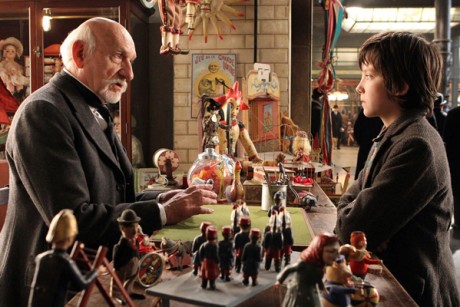
Hugo is a beautiful movie.  I don't like 3-D much at all, but I am sorely disappointed I didn't see it in 3-D (it was, however, a great way to break in a new Blu-Ray!). It is a movie about the movies, a beautiful story set amid beautiful scenery.  It is hard to write about it without spoiling the plot line, but suffice it to say it is about a forgotten man who once was a great artist in his given medium, and how he finds redemption through the persistence of a young boy and girl.

It is, in short, a fictionalized account of the later life of Georges Melies, the early cinematographic genius, famous for his "Voyage to the Moon," in which the rocket launched from Earth hits the Old Man in the Moon in the eye.  Melies was a restless perfectionist and innovator, always driving himself to do better and be better, inventing an art where none had previously existed.

Watching those early movies is fascinating --they are primitive, yet beautiful.  We have come far so very fast in terms of technology.  Sound, then color, then Cinemascope and Panavision, then stereo, then surround, and now digital and CGI.  Hollywood has been restlessly improving itself since its beginnings.

Which makes me think about preaching...

I found a new and insightful blog, pastoralized.com, by Eric McKiddie, one of the pastors of the storied College Church @ Wheaton.  McKiddie is excellent at offering pithy and wise advice to pastors on the whole range of pastoral attitudes and practice.  His blog 12 Ways to Improve Your Preaching in 2012 started quite a lively discussion on my Facebook page.

I work with seminary interns, and one of the things I try to do is to get them to examine the "How" of preaching, in short to be thinking of delivery and how it can be improved.  Seminarians often view sermons as we might view our children --beloved little darlings-- and perish the thought that anyone might tell us we could improve them!  Those who have let me critique their sermons probably wish they hadn't, later (though some come back and thank me).  I have stressed to them that sermons are part art and part science, and, like any skill, we ought to be intent on getting better.  Preaching is part gifting, part caught and part taught.  WE also tend to know it when we hear it, even across a range of styles.

The aspiring preacher needs to find his own voice and cultivate it.  The danger of listening to good preaching is to become a mimic of a good preacher --and the mimics are never as good as the originals.  I firmly believe preachers ought to ingest a regular diet of good preaching for the good of their own souls, and also with an ear towards improving themselves, but to avoid at all costs imitating those whom you hear.

One part of preaching I think that has sadly fallen out of fashion is eliminating notes.  I am no anti-note legalist, but I know, in my case, notes do me far more harm than good.  The danger of "notelessness" is straying off topic, but really this is not difficult to remedy --know what you're going to say, and don't say anything (generally) you hadn't planned to say.  Preaching is oral proclamation, which is a very different thing from written communication, and a sermon that is read, generally, will sound stilted and fail to connect.  I say generally to all this because there are exceptions!

I say this too, because I use notes in the evening, and I know how much less enjoyable preaching is when I do it.

Friends who studied under great homileticians (Henry Bast, Haddon Robinson, Robert Rayburn) all report that it was expected of them not to take notes into the pulpit.  It seems to me that a reasonably intelligent and disciplined man should be able to speak for 25-35 minutes on a topic extemporaneously without veering too far afield.  Sometimes I wonder if this is why so many candidate sermons sound like Bible study notes, and, sadly, many preachers fail to ever advance beyond that.

The danger of all of this is, of course, that I, or any, who venture to opine about preaching may come across as regarding myself (ourselves) as experts, and as gifted preachers.  That is not my intent.  I do think, however, that I generally know what makes for good preaching, about which much more could and should be said (and McKiddie is excellent on this, as is Fred Craddock in his books Preaching and As One Without Authority.)  

The overall point is this: preachers ought to be restless and intentional about improving the "hows" of their preaching --things like structure of argument, rhetorical flow, voice and delivery.  Other preachers care to weigh in?